You’re taking an algebra or precalculus class and encountering sequences. The teacher mentions explicit formula for arithmetic sequence and you wonder what that means and why it matters.
Arithmetic sequence problems appear throughout mathematics. The explicit formula for arithmetic sequence is a key tool for solving them quickly. Understanding this formula saves time on tests and helps you grasp how sequences work.
Let’s break down what these formulas are, why they matter, and how to use them to solve problems.
Understanding Sequences Basics
A sequence is an ordered list of numbers following a pattern. Each number in the sequence is called a term.
Sequences appear everywhere in mathematics. They model growth, decay, and patterns. Understanding sequences builds foundation for studying series, calculus, and other advanced topics.
Different types of sequences follow different patterns. Arithmetic sequences have a constant difference between consecutive terms. Geometric sequences have a constant ratio. Other sequences follow more complex patterns.
Focusing on arithmetic sequences first gives you tools that apply broadly. Many real-world situations create arithmetic sequences.
What Is an Arithmetic Sequence
An arithmetic sequence is a sequence where the difference between any two consecutive terms is constant.
For example: 2, 5, 8, 11, 14… The difference between consecutive terms is always 3. This constant difference is called the common difference.
Another example: 10, 7, 4, 1, -2… The common difference here is -3. It’s negative because the sequence decreases.
The common difference is often written as d. It can be positive (sequence increases), negative (sequence decreases), or zero (all terms are the same).
Recognizing arithmetic sequences is the first step. Once you identify the common difference, you can find any term without listing all previous terms.
The Explicit Formula for Arithmetic Sequence
The explicit formula for arithmetic sequence is a mathematical expression that finds any term directly.
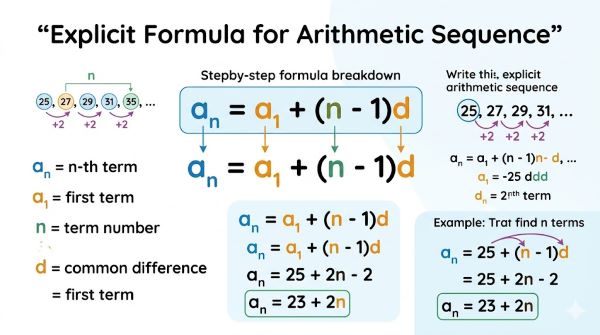
The formula is: aₙ = a₁ + (n-1)d
Where:
- aₙ is the nth term (the term you want to find)
- a₁ is the first term
- n is the position of the term
- d is the common difference
This explicit formula lets you jump directly to any term. You don’t need to calculate all previous terms. Just plug in the position number and you get the answer.
For example, in the sequence 2, 5, 8, 11, 14…
- a₁ = 2 (first term)
- d = 3 (common difference)
- To find the 10th term: a₁₀ = 2 + (10-1)3 = 2 + 27 = 29
Explicit Equation vs Recursive Formula
Understanding the difference between explicit formula and recursive formula is crucial.
A recursive formula for arithmetic sequence defines each term based on the previous term.
The recursive formula for arithmetic sequence looks like: aₙ = aₙ₋₁ + d
This says: the nth term equals the previous term plus the common difference.
Using the same example (2, 5, 8, 11, 14…):
- a₁ = 2
- aₙ = aₙ₋₁ + 3
To find the 10th term recursively, you calculate a₂, then a₃, then a₄… all the way to a₁₀. It takes 9 steps.
The explicit formula finds the 10th term directly in one calculation.
For small positions, both work. For large positions (like finding the 100th term), the explicit formula is far superior.
Recursive Equation Characteristics
A recursive equation defines terms using previous terms. It requires knowing earlier terms to find later ones.
Recursive sequences work like this: start with known values, then use the pattern to build forward.
Advantages:
- Simple to understand conceptually
- Shows how each term relates to previous terms
- Easy to implement in computer programs
Disadvantages:
- Slow for large term positions
- Requires previous terms to calculate a specific term
- Not ideal for finding arbitrary terms
Recursive rule is another term for recursive formula. Both mean the same thing.
Explicit Formula Characteristics
An explicit rule (another name for explicit formula) directly calculates any term using its position.
Advantages:
- Fast calculation of any term
- No need for previous terms
- Easy to find large position terms
- Better for real-world applications
Disadvantages:
- Requires understanding the pattern first
- Takes more setup than recursive formulas
The explicit formula is worth learning because it’s so efficient.
Finding the Explicit Arithmetic Formula
Given an arithmetic sequence, how do you find its explicit formula?
Step 1: Identify the first term (a₁) Step 2: Find the common difference (d) by subtracting any term from the next term Step 3: Use the formula aₙ = a₁ + (n-1)d
Example: 7, 11, 15, 19…
- a₁ = 7
- d = 11 – 7 = 4
- Explicit formula: aₙ = 7 + (n-1)4, which simplifies to aₙ = 4n + 3
Step 3 can go further. We simplify: aₙ = 7 + 4n – 4 = 4n + 3
Now we have a cleaner form: aₙ = 4n + 3
Comparing Recursive and Explicit Formulas
Let’s look at the same sequence using both formulas.
Sequence: 3, 7, 11, 15, 19…
Recursive formula:
- a₁ = 3
- aₙ = aₙ₋₁ + 4
Explicit formula:
- aₙ = 3 + (n-1)4 = 4n – 1
Finding the 50th term:
Recursively: Start with 3, add 4 repeatedly 49 times. (Tedious)
Explicitly: a₅₀ = 4(50) – 1 = 200 – 1 = 199 (One calculation)
The efficiency difference grows with position.
Recursive and Explicit Formulas in Geometric Sequences
Geometric sequences have a constant ratio rather than constant difference.
Example: 2, 6, 18, 54… Each term is 3 times the previous term.
Recursive formula for geometric sequence: aₙ = aₙ₋₁ · r (where r is the common ratio)
Explicit formula for geometric sequence: aₙ = a₁ · r^(n-1)
The principles are similar to arithmetic sequences, but multiplication replaces addition.
Understanding both types of sequences builds mathematical pattern recognition skills.
Arithmetic Explicit Formula Applications
The explicit formula for arithmetic sequence appears in real-world contexts.
Example: You start a job earning $30,000 annually. Each year you get a $2,000 raise.
Year 1: $30,000 Year 2: $32,000 Year 3: $34,000
This is an arithmetic sequence with a₁ = 30,000 and d = 2,000.
Using the explicit formula: Salary in year n = 30,000 + (n-1)(2,000)
To find your salary in year 10: a₁₀ = 30,000 + (10-1)(2,000) = 30,000 + 18,000 = $48,000
Without the explicit formula, you’d calculate each year’s salary individually.
Problem-Solving Strategies
Many problems give you a sequence and ask you to find something.
Given: First term a₁ = 5, common difference d = 3, find the 8th term Solution: a₈ = 5 + (8-1)(3) = 5 + 21 = 26
Given: A sequence has a₃ = 10 and a₇ = 26, find the common difference Solution: The difference from term 3 to term 7 is 26 – 10 = 16 That’s 4 steps (from position 3 to position 7) Common difference per step: 16/4 = 4
Given: An arithmetic sequence has a₁ = 2 and a₁₀ = 29, find d Solution: 29 = 2 + (10-1)d 27 = 9d d = 3
These problems test understanding of how the explicit formula works.
Arithmetic Sequences in Technology
Computer programs use arithmetic sequences frequently.
Loop counters create arithmetic sequences: 1, 2, 3, 4…
Numbering systems use arithmetic sequences. Memory addresses in computers often follow arithmetic patterns.
The explicit formula helps optimize these operations. Rather than calculating incrementally, you jump directly to needed values.
Sequence Formula Variations
Different textbooks write formulas slightly differently.
Some use aₙ = a₁ + (n-1)d Some use f(n) = a + (n-1)d Some use Tₙ = a + (n-1)d
The notation varies but the concept is identical. The nth term equals the first term plus the common difference times (n-1).
Understanding the concept matters more than memorizing specific notation.
Connecting Patterns and Formulas
Looking at a sequence and finding patterns requires observation skills.
Sequence: 5, 10, 15, 20… Pattern: multiples of 5 Common difference: 5 Explicit formula: aₙ = 5n
Sequence: 2, 5, 8, 11… Pattern: differences of 3 Common difference: 3 Explicit formula: aₙ = 3n – 1
Recognizing these patterns becomes automatic with practice.
Key Takeaways
- The explicit formula for arithmetic sequence directly calculates any term using position rather than requiring previous terms.
- The explicit formula for arithmetic sequence is aₙ = a₁ + (n-1)d, where a₁ is the first term, n is the position, and d is the common difference.
- An arithmetic sequence has a constant difference between consecutive terms.
- The common difference is found by subtracting any term from the next term.
- A recursive formula for arithmetic sequence defines each term based on the previous term: aₙ = aₙ₋₁ + d.
- Recursive and explicit formulas both describe the same sequence but in different ways.
- The explicit formula is more efficient for finding large position terms.
- Recursive formula is simpler conceptually but slower for large positions.
- Explicit formula for geometric sequence uses multiplication instead of addition: aₙ = a₁ · r^(n-1).
- Recursive formula for geometric sequence is aₙ = aₙ₋₁ · r.
- Arithmetic formula can be simplified after applying the explicit equation template.
- Recursive equation and recursive formula mean the same thing.
- Explicit rule and explicit formula are interchangeable terms.
- Recursive rule and recursive formula are interchangeable terms.
- Arithmetic sequences appear in real-world applications like salary growth and regular payments.
- Geometric explicit formula follows the same structural logic as arithmetic explicit formula but with different operations.
- Understanding how to find and use the explicit formula for arithmetic sequence is foundational for advanced mathematics.