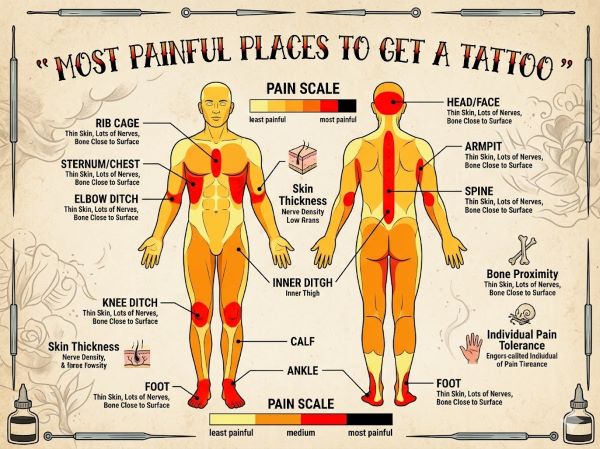
Getting a tattoo means dealing with some level of pain. That’s unavoidable. What’s avoidable is being surprised by just how much pain you’re in. Understanding which body locations hurt more than others helps you make informed decisions about where to place your tattoo.
The most painful places to get a tattoo aren’t necessarily the places you’d expect. Sure, sensitive areas hurt. But there’s more to it than that. Bone proximity, nerve density, and skin tightness all affect pain levels. Understanding these factors helps you prepare mentally and physically for the experience.
Let’s talk honestly about which placements are genuinely painful and why.
Understanding Tattoo Pain
Before diving into specific locations, understanding what causes tattoo pain helps explain the variations.
Tattoo needles penetrate the skin repeatedly at high speed. This creates pain as the needle touches nerve endings. The intensity depends on how many nerves are in the area and how close the skin is to bone.
Bone proximity amplifies pain. When the needle approaches bone, vibrations travel through the bone and intensify the sensation. Areas with bone close to the skin hurt significantly more than areas with soft tissue.
Nerve density matters enormously. Areas with more nerve endings feel more pain. Fingertips have high nerve density, which is why they hurt. The back has lower nerve density, which is why back tattoos hurt less.
Skin thickness affects pain too. Thin skin is more sensitive than thick skin. The inner wrist has thin, sensitive skin. The outer forearm has thicker skin.
Individual pain tolerance varies. What one person finds unbearable, another finds manageable. Age, health, stress levels, and prior pain experiences all affect how you experience tattoo pain.
Tattoo Pain Chart and Rating Systems
A tattoo pain chart helps you understand relative pain levels across different body locations. Different charts rate locations on scales from 1 to 10, with 10 being the most painful.
The tattoo pain scale typically places bone-adjacent areas like ribs, spine, and knees in the 8 to 10 range. These are genuinely painful locations.
Moderately painful areas like the arm, thigh, and calf range from 4 to 6. These are uncomfortable but manageable for most people.
Less painful areas like the shoulder, outer thigh, and upper arm range from 1 to 4. These tend to be the most comfortable placements.
A tattoo pain chart female might differ slightly from male charts because muscle distribution and body composition vary. However, the bone-proximity principle applies to everyone.
The Most Painful Tattoo Spots
Certain locations consistently rank as the most painful. Understanding why helps you understand what to expect.
Sternum tattoo placement is notoriously painful. The sternum is bone with thin skin covering it. The needle vibrates directly against the bone, creating intense pain. Most people rank sternum tattoos as 8 to 9 on the pain scale. The experience is described as sharp, vibrating pain that radiates.
Rib tattoos for men and women are similarly painful. Ribs are bone with relatively thin skin. The constant movement of breathing adds discomfort. You feel every needle movement. Rib tattoos usually range 7 to 9 on the pain scale.
Knee tattoo pain is intense because knees are mostly bone with thin skin. The knee doesn’t have much soft tissue to absorb the needle impact. Expect 8 to 9 on the pain scale. The pain is sharp and concentrated.
Elbow tattoo and elbow tattoos placement includes both the olecranon process (the pointy bone) and the sensitive inner elbow. Both locations hurt significantly. The pointy bone feels like getting a tattoo directly on bone. The inner elbow has thin, sensitive skin. Pain levels reach 7 to 9.
Neck tattoo pain is moderate to high. The neck has sensitive skin and is close to nerves running to the head. A front neck tattoos for men or neck placement for women typically rates 5 to 7 on the pain scale. The vibrations near the head can feel unusual.
Collarbone tattoo and collar bone tattoos placement involves bone with relatively thin skin. Pain ranges from 6 to 8. The bone proximity and skin sensitivity create significant discomfort.
Inner bicep tattoo and inner bicep tattoo men placements hurt because the skin is thin and sensitive. The inner arm has fewer nerve endings than some areas but the sensitivity of the skin makes up for it. Pain rates 5 to 7.
Behind ear tattoos and behind ear tattoos men placements involve thin, sensitive skin in an area with many nerve endings. The proximity to the head adds to the uncomfortable sensation. Pain ranges 5 to 7.
Wrist tattoos for women and wrist tattoos generally are moderately painful. The wrist has thin skin and is sensitive. Pain ranges 4 to 6.
Hand pain diagram shows high sensitivity in hands. Hand tattoos hurt more than many realize. Fingers, palms, and the backs of hands all have high nerve density. Pain ranges 6 to 8.
Inner forearm tattoo placement has moderate pain. The skin is reasonably thick but sensitive. Pain ranges 4 to 6.
Outer forearm tattoos for men and women have lower pain levels. The skin is thicker here. Pain ranges 3 to 5.
Less Painful Tattoo Placements
Understanding less painful options helps you consider alternatives if you’re pain-averse.
Arm tattoos for women on the outer surface are relatively comfortable. Pain ranges 2 to 4.
Bicep tattoos for men on the outer surface have low pain levels. The thick muscle tissue absorbs needle impact. Pain ranges 2 to 4.
Calf tattoos for men and calf tattoos generally have low pain levels. The calf has thick muscle tissue. Pain ranges 2 to 4.
Leg tattoos men on the thigh have moderate pain. The thigh has thicker skin and soft tissue. Pain ranges 3 to 5.
Back tattoos for women and back placement generally have lower pain levels. The back has thicker skin and muscle tissue. Pain ranges 2 to 4.
Chest tattoos pain levels vary based on exact placement. Upper chest near shoulders is less painful than lower chest near the sternum. Chest tattoos for men and women range from 3 to 6 depending on the exact spot.
Small tattoos for men placed on less sensitive areas hurt less simply because the session is shorter. A small arm tattoo might be barely noticeable. A small neck tattoo still hurts because of the location.
Specific Placements and Pain Levels
Let’s break down specific popular placements.
Neck tattoos for black men and all individuals experience moderate pain. The neck’s sensitivity and nerve density create discomfort. However, neck placement is often quick since most neck tattoos are small.
Jaw piercing comparisons are sometimes made to jaw tattoos. While piercings and tattoos use different equipment, jaw-adjacent areas are sensitive. Jaw area tattoos hurt because of the thin skin and proximity to bone.
Above the knee tattoo placement is moderately painful. Above the knee has more soft tissue than directly on the knee. Pain ranges 4 to 6.
Lower back tattoos for women and lower back placement in general is relatively comfortable. The skin is thicker here. Pain ranges 3 to 5.
Penis tattoo pain is intense because of extreme sensitivity. This is rarely done, but when it is, the pain is described as very high. This placement is not recommended.
Factors That Increase Tattoo Pain
Several factors make tattoo pain worse regardless of location.
Session length increases pain accumulation. Longer sessions hurt more because you’re experiencing pain for hours. Your skin becomes increasingly irritated and sensitive.
Ink color affects pain slightly. Black ink requires deeper needle penetration than some other colors. Colors require different needle depths.
Design complexity increases session length, which increases pain.
Your stress level before the appointment affects pain perception. Being anxious makes pain feel worse.
Time of day matters. Evening sessions after you’ve been stressed and tired all day tend to hurt more.
Your overall health matters. If you’re tired, sick, or dehydrated, pain feels worse.
Medication can affect pain perception. Some medications increase pain sensitivity.
Caffeine consumption before your appointment can increase pain sensitivity.
Alcohol the night before can cause dehydration, making pain worse.
Preparing for Painful Tattoo Placements
If you’re getting a tattoo in a painful location, preparation helps.
Sleep well the night before. Rest helps your body handle pain better.
Eat a good meal before your appointment. Low blood sugar makes pain worse.
Hydrate thoroughly in the days before. Dehydrated skin hurts more.
Avoid caffeine the day of your appointment. It increases pain sensitivity.
Don’t drink alcohol the night before. Alcohol dehydrates you.
Take breaks during the session if available. A five-minute break can reset your pain perception.
Use numbing cream if your artist allows it. Some artists are willing to apply numbing products.
Distract yourself during the session. Listen to music. Focus on your breathing.
Bring a friend if the artist allows it. Having someone present can help you stay calm.
Have realistic expectations. Knowing it will hurt helps you prepare mentally. Many people report that anticipatory anxiety is worse than the actual pain.
Coping Strategies During Your Tattoo
Managing pain during the actual session helps you get through it.
Breathing matters. Slow, deep breathing calms your nervous system. Focus on your breath.
Positive visualization helps. Imagine the finished tattoo. Think about how proud you’ll be.
Conversation can help. Chat with your artist. Distraction through conversation reduces pain perception.
Pressure application sometimes helps. Squeezing something or tensing your muscles can reduce pain perception.
Acknowledging the pain without fighting it helps. Accept that it hurts. Fighting against the pain makes it feel worse.
Knowing it’s temporary helps. The pain will end. It won’t last forever.
Tattoo Pain vs Other Body Modifications
Understanding how tattoo pain compares to other experiences helps contextualize it.
Piercings hurt during the puncture but the pain is brief. Tattoos hurt for hours because the needles repeatedly penetrate.
Injections hurt for seconds. Tattoos hurt for the entire session.
Sunburns hurt constantly without relief. Tattoo pain is sharper but you can take breaks.
Most people who’ve experienced both say tattoos hurt more than piercings but less intensely than serious injuries.
How Much Are Tattoos
How much are tattoos varies based on size, complexity, and location. Pain level doesn’t directly affect price, though painful placements might cost more because they’re more difficult to execute properly.
Simple arm tattoos might cost 50 to 100 dollars. Large back pieces might cost 500 to 2000 dollars. Neck and face tattoos often cost more because of the difficulty.
The cost reflects the artist’s skill, not pain involved. Don’t assume that painful locations are more expensive, though some artists charge more for difficult placements.
Do Tattoos Hurt: Honest Assessment
Do tattoos hurt is the question everyone asks. The honest answer is yes, they hurt. How much depends on location and pain tolerance.
Most people find the pain manageable. It’s not pleasant, but it’s not unbearable. People get through it. Many people get multiple tattoos despite the pain.
The pain is different from other pains. It’s a sharp, burning sensation rather than the sharp agony of an injury. Most people describe it as unpleasant but tolerable.
Most Painful Tattoo Spots Summary
The most painful tattoo spots in descending order of pain:
- Sternum
- Ribs
- Knees
- Elbows
- Collarbone
- Neck
- Inner Bicep
- Behind Ear
- Hands
- Inner Forearm
These locations hurt because of bone proximity, thin skin, or high nerve density.
Key Takeaways
- Most painful places to get a tattoo include bone-adjacent areas like sternum, ribs, knees, and elbows.
- Tattoo pain chart resources show relative pain levels by body location, typically rating 1 to 10.
- Sternum tattoo placement is among the most painful due to direct bone proximity and thin skin.
- Rib tattoos for men and women hurt significantly because of bone and breathing movement.
- Knee tattoo pain is intense because knees are mostly bone with little soft tissue.
- Elbow tattoo placements hurt because of bone prominence and thin skin.
- Neck tattoo pain is moderate to high due to skin sensitivity and nerve proximity.
- Collarbone tattoo placement involves bone with thin skin, creating significant pain.
- Inner bicep tattoo hurts more than outer bicep due to thin, sensitive skin.
- Chest tattoos pain level depends on exact placement, with lower chest near sternum being more painful.
- Back tattoos for women and back placement generally has lower pain levels due to thick skin and muscle tissue.
- Small tattoos for men hurt less when placed in low-pain areas but still hurt based on location, not size.
- Pain preparation includes sleeping well, staying hydrated, avoiding caffeine, and using distraction techniques.
- Do tattoos hurt is yes, but most people find it manageable rather than unbearable.
- How much are tattoos varies based on size and complexity, not primarily on pain level.
- Individual pain tolerance varies significantly. What one person finds unbearable, another finds manageable.
- If you’re pain-averse, choose locations like the outer arm, calf, or shoulder rather than bone-adjacent areas.
- The pain is temporary. Sessions end. The pain stops. You’ll have a tattoo you wanted.
- If you’re considering a tattoo in a painful location, prepare properly and focus on the finished result.