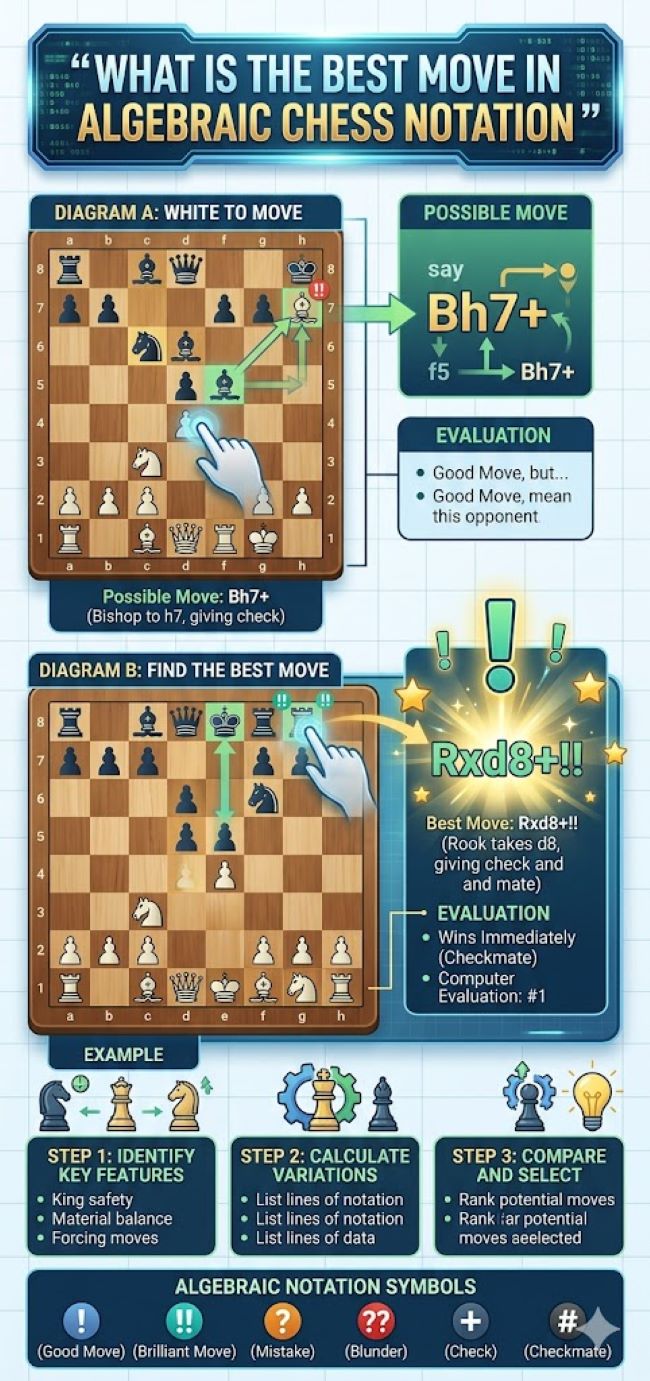
Chess is a game where every move matters. But the question “what is the best move in algebraic chess notation” isn’t about one specific move. It’s about understanding how to evaluate moves using a standardized system that chess players worldwide use to communicate and analyze positions.
If you’re new to chess, algebraic notation might seem like a foreign language. Letters and numbers on squares. Piece abbreviations. It’s confusing at first. But once you understand the system, it becomes clear and powerful. You can read chess books, analyze games, and communicate with other players without confusion.
Let’s talk about how this notation system works and how to identify good moves within it.
Understanding Algebraic Chess Notation
Algebraic chess notation is the standard system chess players use to record moves. Every square on the chess board has a designation. Every piece has an abbreviation. Every move is recorded in a consistent way.
The chess squares are labeled using coordinates. Files are labeled a through h from left to right. Ranks are labeled 1 through 8 from bottom to top. This creates a grid. The square at the bottom left is a1. The square at the top right is h8.
A move is recorded by the piece abbreviation followed by the square it moves to. A knight moving to e4 is written Ne4. A pawn moving to d4 is written d4 (pawns don’t use abbreviations).
Universal piece codes are standardized:
- K for King
- Q for Queen
- R for Rook
- B for Bishop
- N for Knight
- Pawns have no symbol
Understanding this system is foundational to discussing chess moves in any meaningful way.
How to Set Up a Chess Board
Before discussing moves, you need to understand how to set up a chess board properly.
The chess layout follows specific rules. The board always positions so a light square sits in the bottom right corner from white’s perspective. This is essential. If you set up the board incorrectly, all coordinates are wrong.
How to set up chess board correctly means:
- The first rank (bottom row for white) contains the back row pieces
- The second rank contains the pawns
- Pieces mirror on each side
- The king starts on its own color
- The queen starts on the opposite color from the king
More specifically:
Starting from the left on rank 1 for white: rook, knight, bishop, queen, king, bishop, knight, rook.
Rank 2 contains eight pawns.
Black’s pieces mirror this on ranks 7 and 8.
Once set up chess board correctly, the chess board numbers and letters coordinate to real positions.
Chess Moves and Notation
Chess moves follow specific rules depending on the piece. Understanding how different pieces move helps you read notation.
Knight moves in chess are unique. Knights move in an L-shape: two squares in one direction, then one square perpendicular. A chess knight cannot move to a square only one square away. The notation Ne4 means the knight moves to e4. From where depends on which knights can reach that square.
Bishops move diagonally any number of squares.
Rooks move horizontally or vertically any number of squares.
Queens move like bishops or rooks combined.
Kings move one square in any direction.
Pawns move forward one square normally, or two squares from their starting position. They capture diagonally forward one square.
Identifying the Best Chess Move
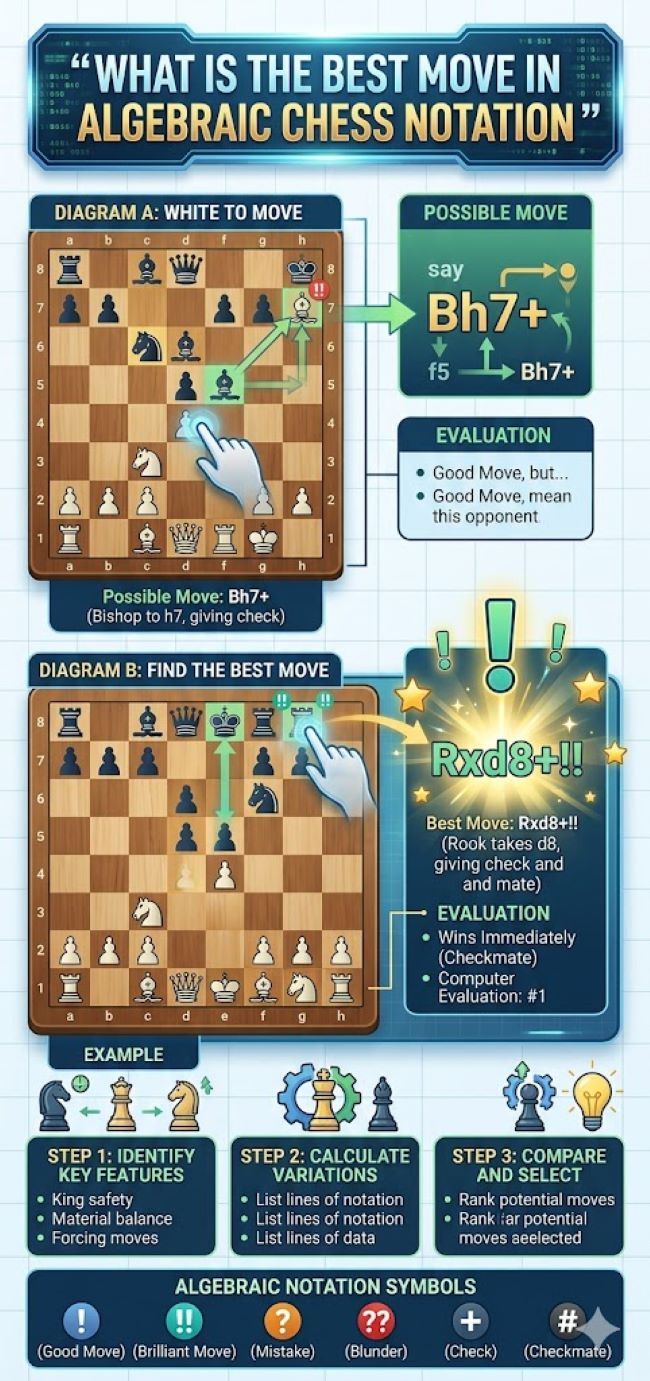
Best chess move identification requires understanding several factors.
Material advantage matters. A move that captures an opponent’s piece without losing your piece is good. Capturing a queen with a pawn is one of the best trades possible.
Positional advantage matters. A move that improves your piece placement, attacks weak squares, or develops your position is good.
Safety matters. A move that puts your king in danger or leaves your pieces undefended is bad.
Tempo matters. Forcing your opponent to respond to threats gives you initiative.
The “best move” depends on the specific position. In an opening, developing your pieces is important. In the middle game, attacking the opponent’s weak points matters. In an endgame, promoting pawns becomes critical.
Evaluating moves requires considering all these factors.
Algebraic Notation Details
Algebraic chess notation includes additional symbols for clarity.
Captures are marked with an x. A rook capturing on d4 is written Rxd4. This tells you the rook captured something on d4.
Check is marked with a plus sign. Kg1+ means the king moved to g1 and is giving check.
Checkmate is marked with a hash or # symbol. Qh7# means the queen moved to h7 and achieved checkmate.
Disambiguation occurs when multiple pieces of the same type can move to the same square. If two knights can reach e4, the notation might be N1e4 (the knight on the first rank) or Nfe4 (the knight from the f-file).
Castling is written 0-0 for kingside castling or 0-0-0 for queenside castling.
Pawn promotion is written with the new piece after the square. e8=Q means a pawn promoted to a queen on e8.
The Next Best Chess Move Concept
Finding the next best chess move requires analyzing the position after your previous move. Chess is a dynamic game. What was good in one position might be bad in the next.
Strong players constantly evaluate what their opponent’s best response will be. They ask: if I make this move, what’s my opponent’s best reply? If their best reply ruins my plan, the move isn’t good even if it looks good in isolation.
The next move chess analysis continues multiple moves deep. Chess engines evaluate 20 or 30 moves ahead. Strong human players evaluate 5 to 10 moves ahead. Even beginners benefit from thinking one or two moves ahead.
Best Move in Algebraic Chess Notation Examples
Let’s look at practical examples of how moves are written.
In the starting position, white can make several moves. Common opening moves include:
- e4 (pawn to e4) is called the Italian opening
- d4 (pawn to d4) is called the Queen’s Gambit
- Nf3 (knight to f3) is flexible and leads to many openings
Each move written in algebraic notation has a specific meaning. e4 is clear. Everyone knows what e4 means.
After 1.e4, black might respond with 1…c5, 1…e5, or other moves. The notation clearly shows which moves happened.
Understanding Chess Notation Systems
Chess notation wasn’t always algebraic. Earlier systems included:
Descriptive notation named squares from the player’s perspective. A move might be written P-K4 (Pawn to King 4). This system was confusing because the same square had two names.
Long algebraic notation writes the starting square and ending square. A move is e2e4 (from e2 to e4). This is unambiguous but verbose.
Standard algebraic notation (what we’ve been discussing) balances clarity with brevity. Just the destination square is needed unless ambiguity exists.
Algebraic chess notation became the standard because it’s clear, concise, and international. Players from any country can read and understand it.
Rule 16 Password Game and Chess
You might encounter “rule 16 password game” in context of chess. This refers to a puzzle game where one of the rules involves chess. The specific rule requires understanding chess notation or moves.
The password game tests knowledge of various fields including chess. Understanding algebraic notation helps you solve password game challenges that involve chess.
Move Chess Board Concepts
Move chess board refers to how pieces physically move on the board. But it also refers to how these physical movements translate to notation.
When you move a piece on the board, you’re executing a move recorded in notation. If you move your knight from g1 to f3, that move is written Nf3 in algebraic notation.
Understanding how board movements translate to notation is essential for reading and recording games.
The Opening: Finding Good Moves
In the opening, the best moves follow principles:
Control the center. Moves like e4, d4, c4, and Nf3 control central squares.
Develop pieces. Moving bishops and knights out to active squares is good. Moves like Nf3, Bc4, and Nbd2 develop pieces.
Avoid moving the same piece twice. Moving the queen out early and moving it again wastes time.
Don’t bring your king into danger. Castling early is usually good because it moves the king to safety.
The opening phase lasts roughly 10 to 15 moves. Good opening moves follow these principles.
The Middle Game: Calculating Tactics
In the middle game, finding the best move requires tactical calculation.
Look for forcing moves. Checks, captures, and threats force your opponent to respond.
Calculate variations. If I make this move, what will my opponent do? If they do that, what will I do? Think several moves ahead.
Avoid hanging pieces. A hung piece is one you’ve left undefended. Your opponent will capture it for free.
Look for weak squares. Squares your opponent can’t defend become targets.
The middle game is where the most interesting chess happens. Finding the best move requires deep calculation and understanding the position.
The Endgame: Concrete Play
In the endgame, finding the best move becomes more concrete.
Promote pawns. The endgame often revolves around getting pawns to the eighth rank to promote.
Activate your king. The king becomes a strong attacking piece in the endgame.
Create passed pawns. A passed pawn (one no opposing pawns can stop) is extremely valuable.
Checkmate patterns matter. Knowing how to checkmate with different piece combinations is essential.
Endgame play is often the most concrete. The best move is often objectively clear because there are fewer pieces and the goal is obvious.
Capital Pawn and Notation
Capital pawn seems to contradict the notation system. Pawns don’t have symbols. They’re written without capitalization. A pawn moving to e4 is written e4, not Pe4.
If you see “capital pawn,” it might be a typo or refer to specific software. In standard algebraic notation, pawns are never capitalized.
Universal Piece Codes Recap
The universal piece codes ensure consistency:
K = King Q = Queen R = Rook B = Bishop N = Knight (Nothing) = Pawn
These codes are universal. Every chess player, computer program, and publication uses these same codes.
Evaluating Positions
To find the best move, you need to evaluate the position:
Material count. How much is each side worth?
Piece activity. Are pieces well-placed or poorly placed?
King safety. Is the king safe or under attack?
Pawn structure. Are pawns weak or strong?
Space control. Which side controls more squares?
Evaluating these factors helps you understand what’s most important in the position and what moves address those factors.
Learning to Find Better Moves
Improving your move selection requires practice:
Study opening principles. Learn what moves strong players make in opening positions.
Solve tactical puzzles. Practice finding forcing moves and combinations.
Analyze your games. Review your games and analyze what moves you played and what better moves existed.
Use chess engines. Modern chess software shows you strong moves for any position.
Play stronger opponents. Playing against stronger players forces you to find better moves.
The best move in any position is the one that gives you the best outcome. Finding that move requires knowledge, calculation, and practice.
Key Takeaways
- What is the best move in algebraic chess notation depends on the specific position and requires understanding chess principles.
- Algebraic chess notation uses piece symbols and square coordinates to record moves clearly and concisely.
- Chess notation system labels squares with files (a-h) and ranks (1-8), creating coordinates for every square.
- Best chess move identification requires considering material, position, safety, and opportunities.
- Chess moves follow specific rules for each piece type. Knights move in L-shapes. Bishops move diagonally.
- Chess knight notation uses N for the piece symbol. Ne4 means the knight moves to e4.
- How to set up a chess board correctly is essential. Light square goes on the bottom right from white’s perspective.
- Chess board numbers (ranks 1-8) and letters (files a-h) create the coordinate system.
- Chess layout has pieces on ranks 1-2 for white and 7-8 for black, mirrored on each side.
- Next best chess move requires analyzing your opponent’s best response to your move.
- Knight moves in chess follow an L-shaped pattern: two squares in one direction, then one perpendicular.
- Move chess board refers to how pieces move on the board and how those movements translate to notation.
- Universal piece codes ensure consistency: K, Q, R, B, N for pieces, and nothing for pawns.
- Capital pawn notation is incorrect. Pawns are written without capitalization or symbols.
- Finding the best move requires evaluating material advantage, positional factors, safety, and opportunities.
- In the opening, follow principles of controlling the center and developing pieces.
- In the middle game, calculate tactics and look for forcing moves.
- In the endgame, promote pawns and activate your king.
- Improving move selection requires studying openings, solving puzzles, analyzing your games, and playing stronger opponents.
- If you’re learning chess, understanding algebraic notation is essential for reading games, studying theory, and communicating with other players.