You stare at a passage and a prompt asking you to analyze its rhetoric. The page looks blank. You’re not sure where to start or what the teacher wants. The AP Lang exam looms. How to write a rhetorical analysis essay AP Lang feels overwhelming.
Here’s the reality: rhetorical analysis isn’t mysterious. It’s a skill you can learn and master with practice. Breaking down how writers use language to persuade, inform, or move their audience is the entire point. Understanding the mechanics transforms a confusing task into a straightforward process.
This guide walks you through how to write a rhetorical analysis from reading the passage to submitting your essay. You’ll learn the structure, discover the most important rhetorical techniques to identify, and see how to explain them clearly. By the end, rhetorical analysis essay writing becomes manageable.
Understanding What Rhetorical Analysis Actually Is
The Core Purpose
What is rhetorical analysis boils down to this: examining how a writer uses language and techniques to achieve a specific purpose with a specific audience.
You’re not judging whether the argument is right or wrong. You’re not saying whether you agree or disagree. You’re explaining the strategies the writer uses to persuade or move people.
A rhetorical analysis essay examines the choices a writer makes. Every word, sentence structure, and reference serves a purpose. Your job is to identify those choices and explain their effects.
Rhetoric Defined
Rhetoric is the art of persuasion. It’s how writers convince, inspire, or move their audiences. Understanding rhetoric means understanding persuasion.
Ancient Greeks studied rhetoric for thousands of years. They identified patterns in how effective communicators work. Those patterns still apply today.
Why This Matters for AP Lang
The AP Language and Composition exam requires rhetorical analysis. The test assumes you can identify when a writer uses specific techniques and explain why those techniques work.
This skill goes beyond AP Lang. Understanding rhetoric helps you identify propaganda, recognize manipulation, and become a more critical consumer of information.
Identifying Rhetorical Choices and Techniques
The Main Rhetorical Techniques
Ethos appeals to credibility and trustworthiness. A doctor talking about health has built-in ethos. A company using customer testimonials builds ethos.
Pathos appeals to emotions. Stories that make you sad or angry use pathos. Images that inspire use pathos.
Logos appeals to logic and reason. Statistics, facts, and logical arguments use logos.
Tone sets the emotional atmosphere. Is the writer angry, sarcastic, formal, casual? Tone shapes how readers receive the message.
Diction is word choice. Specific words carry specific connotations. Calling something “thrifty” versus “cheap” shapes perception.
Syntax is sentence structure. Short sentences feel punchy. Long sentences feel complex or breathless. Repetition builds emphasis.
Imagery uses descriptive language to create mental pictures. Vivid descriptions engage the reader’s senses.
Metaphor and simile compare things to create understanding. Metaphors create surprising connections. Similes use “like” or “as” for comparison.
Allusion references other works, events, or famous people. Allusions add depth and credibility.
Repetition hammers home an idea. Repeating a phrase creates emphasis and rhythm.
Rhetorical Choices AP Lang You’ll See Most
The AP exam especially focuses on these choices:
- Word choice and connotation
- Sentence structure variety
- Point of view and perspective
- Use of concrete examples and evidence
- Appeals to the audience’s values and concerns
- Tone and mood
These appear in nearly every passage. Get good at spotting them and you’ll handle most prompts.
Analyzing Rhetorical Techniques Effectively
How to Examine a Writer’s Choices
Read the passage first without taking notes. Get a sense of the main argument and tone.
Read it again, marking passages that stand out. Look for moments where the writer’s language feels particularly powerful or persuasive.
Ask yourself: Why did the writer phrase it this way instead of another way? What does this choice communicate to the reader?
Consider the effect on the audience. Does this choice make readers more likely to agree? Does it make them feel something? Does it help them understand?
Connect the technique to the overall purpose. How does this specific choice support the main argument?
Rhetorical Analysis Example Analysis
Let’s say a passage says: “We are not just fighting a disease. We are fighting for our lives, our families, our future.”
The technique is anaphora (repetition of words at the beginning of phrases). The repeated “our” emphasizes collective ownership and stakes.
The effect is pathos and empowerment. Readers feel like part of something larger. The stakes feel personal and urgent.
The overall purpose is to rally people to action. By making the fight personal and collective, the writer motivates support.
This is how you analyze. Identify the technique, explain the effect, connect it to purpose.
Building Your Rhetorical Analysis Essay Outline
The Structure That Works
Introduction introduces the passage and author, states the main argument, and previews the techniques you’ll analyze.
Body paragraphs each focus on one or two related techniques. Explain what the writer does, show evidence from the text, and explain the effect.
Conclusion synthesizes your analysis, restates the writer’s overall rhetorical strategy, and explains the effectiveness of the approach.
Writing Your Introduction
Name the author and passage. Give basic context about when or where it was published if relevant.
State what the passage argues or tries to accomplish. What’s the main point?
Identify the intended audience. Who is this written for?
Preview your analysis. What techniques will you examine?
Example: “In this op-ed published in the New York Times, the author argues that social media companies need stricter regulation. Writing to a general, educated audience, she builds her argument primarily through logical appeals supported by expert testimony and data.”
This introduction tells the reader what’s coming and hints at your analysis.
Structure Your Body Paragraphs
Topic sentence identifies the technique or techniques you’re analyzing.
Evidence shows specific quotes or examples from the text.
Analysis explains how the technique works and what effect it creates.
Connection ties the technique back to the overall purpose and audience.
Example paragraph structure:
“The author relies heavily on logos to establish her argument’s credibility. She cites studies showing a 40 percent increase in teen depression correlated with increased social media use. This data appeals to readers’ rational side by providing measurable evidence. By grounding her argument in numbers rather than opinion, she makes her claim harder to dismiss. This logical approach works because her audience, educated newspaper readers, respects evidence-based reasoning.”
This paragraph shows technique, evidence, analysis, and connection.
Concluding Your Analysis
Restate the writer’s main argument and the techniques examined.
Synthesize your findings. How do the techniques work together?
Discuss the overall effectiveness. Did the writer successfully persuade or move the audience?
Don’t just summarize. Push your thinking one step further.
Common Mistakes to Avoid
Misunderstanding the Assignment
Don’t evaluate whether you agree with the argument. That’s not rhetorical analysis.
Don’t identify techniques without explaining their effects. Naming a technique means nothing without analysis.
Don’t assume techniques are always effective. Sometimes writers use techniques poorly. Analyze whether they work.
Weak Evidence and Analysis
Don’t quote without analyzing. Every quote needs explanation of how it demonstrates your point.
Don’t vaguely describe techniques. Be specific about word choice, sentence structure, or other elements.
Don’t skip the “so what” step. Always explain why the technique matters.
Structural Issues
Don’t cram too many techniques into one paragraph. Focus on one or two per paragraph.
Don’t introduce new evidence in your conclusion. Save everything important for your body.
Don’t write a summary instead of analysis. Summarizing is not analyzing.
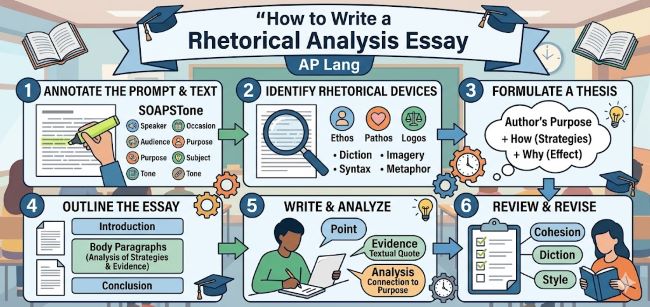
How to Write a Rhetorical Analysis Step by Step
Step One: Read Actively
Read the passage multiple times. Mark passages that stick out. Note the tone, audience, and main argument.
Ask questions: Who wrote this? When? For what publication? Who reads it? What problem is it addressing?
Step Two: Identify Techniques
Reread and mark specific techniques. Label them. Note where they appear.
Don’t try to identify every technique. Focus on the most important ones that support the main argument.
Step Three: Analyze Effects
For each technique, ask: Why did the writer choose this? What does it communicate? How does it persuade the audience?
Write a few sentences explaining each technique’s effect. These become your analysis.
Step Four: Build Your Outline
Map your introduction, body paragraphs, and conclusion.
Decide which techniques to analyze. Choose the strongest ones.
Order your paragraphs logically. You might go from strongest to weakest, or organize by audience appeal type.
Step Five: Write Your Draft
Write your introduction. Be clear about the passage’s argument and audience.
Write your body paragraphs. Start with a technique, show evidence, analyze the effect, connect to purpose.
Write your conclusion. Synthesize your findings without simply summarizing.
Step Six: Revise
Read your draft aloud. Does it flow? Are your points clear?
Check that every sentence serves a purpose. Cut anything that doesn’t contribute to your analysis.
Verify that you’ve analyzed, not just described. Every technique needs explanation of its effect.
Rhetorical Analysis Essay Example Structures
The Ethos-Based Essay
Some passages build credibility and authority. These essays focus on how writers establish expertise, use trustworthy sources, or position themselves as credible.
Thesis might be: “The author establishes credibility through personal experience and expert citations, making her argument persuasive to skeptical readers.”
The Pathos-Based Essay
Some passages appeal to emotions and values. These essays examine how writers create emotional responses.
Thesis might be: “By using personal narratives and vivid imagery, the author creates emotional investment in her argument, moving readers to action.”
The Logos-Based Essay
Some passages rely on facts, data, and logical reasoning. These essays trace how writers build rational arguments.
Thesis might be: “The author supports her claim with statistical evidence and logical progression, appealing to the reasoning of educated readers.”
The Mixed Approach
Most strong passages use all three appeals plus other techniques. These essays synthesize multiple elements.
Thesis might be: “The author combines personal credibility, emotional appeals, and logical evidence to create a multifaceted argument that reaches diverse readers.”
Connecting AP Lang Rhetorical Analysis Essay to the Exam
What the Rubric Values
Clear identification of rhetorical techniques.
Accurate analysis of how techniques create effects.
Proper grammar and clear writing.
Relevant evidence supporting your analysis.
Time Management During the Exam
Spend 5 minutes reading and annotating the passage.
Spend 5 minutes planning your essay and identifying techniques.
Spend 25 minutes writing.
Spend 5 minutes reviewing and fixing errors.
This timing ensures you complete a solid essay within the time limit.
Practice Makes Perfect
Write practice essays regularly. Time yourself.
Read sample essays. Notice what strong analysis looks like.
Seek feedback from your teacher. Understand where your analysis falls short.
Revise based on feedback. Growth comes from targeted practice.
Understanding Rhetorical Techniques in Context
Techniques Change by Medium
Rhetorical techniques work differently in speeches versus essays versus advertisements.
A speech might use repetition and parallelism for memorable phrases.
An advertisement might use imagery and emotional appeals for impact.
An essay might use evidence and logical structure for persuasion.
Understanding the medium helps you identify which techniques matter most.
Synthesis Essay AP Lang Connections
Some AP Lang prompts ask for synthesis essays that combine rhetorical analysis with your own argument.
These require analyzing sources’ rhetoric while building your own argument.
The same rhetorical analysis skills apply. You examine how sources persuade, then use similar techniques in your own writing.
Key Takeaways
- How to write a rhetorical analysis essay AP Lang starts with understanding that you’re examining the writer’s choices and their effects, not judging whether you agree.
- Rhetorical analysis breaks down the techniques writers use to persuade, inform, or move their audiences.
- Rhetorical techniques include ethos, pathos, logos, tone, diction, syntax, imagery, metaphor, and many others.
- What is rhetorical analysis asking? To explain how specific language choices support the writer’s purpose with a specific audience.
- Rhetorical analysis essay structure includes introduction, body paragraphs analyzing specific techniques, and a conclusion synthesizing your findings.
- Rhetorical choices AP Lang most focuses on word choice, sentence structure, point of view, evidence use, and tone.
- Rhetorical question examples are one technique among many. Don’t rely on finding questions. Analyze the broader strategies.
- How to write a rhetorical analysis means identifying techniques, explaining their effects, and connecting them to the overall purpose.
- Rhetorical analysis essay outline organizes your thinking before you write, making the actual essay easier.
- Rhetorical analysis example analysis shows technique, evidence, effect analysis, and connection to purpose in every paragraph.
- Rhetorical analysis essay example structures vary based on which appeals dominate the passage, but all follow the same analytical approach.
- Rhetorical essay writing improves with practice. Write multiple essays, seek feedback, and revise based on what you learn.
- AP lang rhetorical analysis essay success comes from clear identification of techniques, accurate analysis of effects, and strong connection to the writer’s purpose.
- Avoid common mistakes: Don’t evaluate the argument, don’t name techniques without analyzing them, and don’t summarize instead of analyze.
- Time yourself during practice. The exam gives limited time, so efficiency matters.