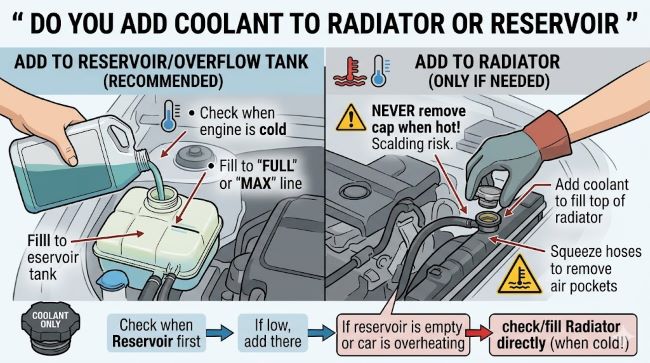
Staring at your engine bay, you see two different places where coolant could go. One’s the radiator. The other’s a plastic tank nearby. So which one actually gets the coolant? The answer matters more than you’d think, and getting it wrong can damage your engine.
The answer is simple: you add coolant to the reservoir, not directly to the radiator. But there’s more to it than that. Understanding why matters, and knowing how to do it correctly will save you from costly mistakes.
Understanding Your Cooling System
Your car’s cooling system is basically a loop. Coolant flows from the engine to the radiator, where it cools down, then back to the engine to absorb heat again. The radiator overflow tank (also called the expansion tank or coolant reservoir) is part of this system, and it’s the correct place to add coolant in your car.
The reservoir serves a real purpose. As your engine heats up, coolant expands. The reservoir catches this excess. When the engine cools, coolant contracts back down. Without it, you’d either have coolant overflowing everywhere or creating a vacuum in your system.
The radiator itself is designed to handle heated coolant flow. Adding coolant directly to the radiator cap while the engine is running is actually dangerous. The system is pressurized, and opening the radiator cap on a hot engine releases that pressure suddenly. Coolant sprays out, potentially scalding you.
Do You Add Coolant to Radiator or Reservoir?
Here’s the clearest answer to “do you add coolant to radiator or reservoir”: you add it to the reservoir every time. This is where radiator fluid goes in modern vehicles.
The radiator itself only needs attention if you’re doing serious maintenance or repairs. For routine coolant top-ups, the reservoir is the only place you touch. Open the cap on that plastic tank, pour your coolant in, and you’re done.
Why this design? Because the reservoir is accessible, safer to open, and designed specifically for this task. The radiator cap should stay closed unless you’re flushing the entire system or replacing components. Even then, you do it when the engine is completely cold.
Never add coolant to a hot radiator. The pressure inside can cause the cap to shoot off and spray scalding coolant. This isn’t theoretical risk. It happens regularly to people who don’t know better. Wait until the engine cools, and use the reservoir.
Where Does Coolant Go in a Car?
To answer “where does coolant go,” you need to know what you’re looking at. The reservoir is usually a translucent plastic tank mounted to the side of the engine bay. You can see the coolant level through the plastic. Some cars have it on the right side, some on the left. Check your owner’s manual if you’re not sure.
The cap on the reservoir typically says “Coolant” or has a thermometer symbol. It’s much easier to open than the radiator cap. You can grip it with your bare hand without burning yourself because the system isn’t under the same pressure.
When you open the reservoir and look inside, you’ll see minimum and maximum marks on the side. These show you where the level should be. If your coolant is low, you refill it at the reservoir. This is where you put coolant in your car for routine maintenance.
The radiator is the large metal object with fins, usually in front of the air conditioning condenser. It has its own cap, but that’s for the pressurized cooling system. Don’t touch it during routine top-ups.
Where to Put Coolant in Car: Step-by-Step
Adding coolant to your car is straightforward, but doing it correctly matters.
Step 1: Let the engine cool Never work on a hot cooling system. Turn off the engine and wait at least 30 minutes. The system is pressurized when hot, and you risk severe burns. Cold is the safe choice.
Step 2: Locate the coolant reservoir Pop open your hood and find the plastic reservoir. It’s usually white or clear, somewhere on the side of the engine bay. Your owner’s manual shows the exact location if you can’t find it.
Step 3: Check the level Look at the side of the tank. You should see minimum and maximum lines. The current level should fall between these marks. If it’s at or below minimum, you need to add coolant.
Step 4: Choose the right coolant Different cars need different coolant types. Some use green antifreeze. Others use orange or pink. Check your owner’s manual or look at what’s already in your car. Using the wrong type can cause deposits and reduce cooling efficiency.
Step 5: Open the cap carefully Twist the cap on the reservoir counterclockwise. If there’s any steam or hissing, stop and wait longer. Once the cap is off, you’re ready to refill.
Step 6: Pour coolant into the reservoir Use a funnel if you have one to avoid spilling. Pour slowly. Watch the level climb inside the tank. Stop when you reach the maximum mark.
Step 7: Replace the cap Twist the cap back on clockwise until it’s snug. Don’t force it. Start your engine and check that no leaks develop.
How to Add Coolant to Car: Common Mistakes
People make predictable mistakes when adding coolant. Knowing them helps you avoid them.
The biggest mistake is opening the radiator cap instead of the reservoir cap. They’re not the same. The radiator is pressurized. The reservoir is not. One is safe to open when the engine is cold. The other can burn you even after waiting.
Another common error is mixing coolant types. If your car uses orange coolant and you pour in green, you create sludge in the system. This blocks water passages and causes overheating. Stick with what your car came with.
Some people add straight water when they’re out of coolant. Water alone works in an emergency for short distances, but it freezes in winter and boils in summer. Actual coolant has additives that prevent both. Use real coolant, not tap water.
Overfilling is another mistake. If you fill above the maximum mark, excess coolant pushes out when the system heats up and expands. This wastes coolant and can damage other engine components if it spills on them.
Forgetting to put the cap back on is rarer but still happens. You’ll notice pretty quickly when steam starts coming from under the hood.
Radiator Fluid vs Coolant: Are They the Same?
People sometimes ask if radiator fluid and coolant are different. The answer is basically no. These terms are interchangeable. Radiator fluid is coolant. Coolant is what goes in your radiator system. Some older people call it antifreeze, which is partially accurate but incomplete.
Antifreeze is one component of coolant. Coolant also contains water, additives that prevent corrosion, and lubricants for the water pump. Antifreeze is just the part that keeps it from freezing or boiling at extreme temperatures.
When you’re buying the stuff at an auto parts store, it’s labeled as coolant. When you check your engine, it’s called coolant. For all practical purposes, radiator fluid and coolant mean the same thing. You’re putting the same liquid in the same place.
The key is using the right type for your vehicle. Not all coolants are the same. Long-life coolants last longer than conventional types. Some cars specify 50/50 premix, while others want concentrate that you mix with water yourself.
Can You Add Water to Coolant?
This question comes up a lot, especially when people are in a pinch. Can you add water to coolant if you don’t have more coolant handy?
The short answer is: not really. Water alone is not adequate. In an emergency, water works for a short drive to get to a shop. But as a permanent solution, it fails.
Here’s why. Pure water freezes at 32 degrees Fahrenheit. In winter, your engine cooling system would freeze solid, cracking the block. Pure water also boils at 212 degrees. In summer driving or stop-and-go traffic, your engine would overheat fast.
Coolant has antifreeze additives that lower the freezing point to around -30 degrees and raise the boiling point to around 265 degrees. These are necessary for year-round driving.
Water also lacks the corrosion inhibitors in proper coolant. Your cooling system has brass, aluminum, and steel components. Without corrosion inhibitors, they rust internally. This clogs passages and reduces cooling efficiency.
The bottom line: use real coolant, not water, except in a genuine emergency where you’re driving to the nearest auto shop. Once you get there, flush out the water and refill with proper coolant.
How Much Coolant Do I Need?
A common question when refilling is how much coolant you actually need. The answer depends on how low your system is.
Most of the time, you’re doing a small top-up. The reservoir shows you minimum and maximum marks. Fill to maximum, and you’re done. This usually means adding a quart or less.
If you’re doing a complete flush and refill, you need more. Most cars hold between 10 and 20 quarts of coolant total. Your owner’s manual tells you the exact capacity.
When adding coolant, it’s better to add less than too much. You can always add more later. Overfilled systems push out coolant when it heats and expands. You end up with puddles under your car and an underful system when it cools again.
If you’re not sure how much you need, start by adding one quart at the reservoir. Check the level. Most cars have a window or translucent tank, so you can see if you’ve reached the maximum mark. Add more if needed.
For a complete system refill, consult your owner’s manual or ask at an auto parts store. They can tell you the capacity and what type to buy.
Where Does Antifreeze Go in a Car?
Antifreeze and coolant go to the same place. The answer to “where does antifreeze go” is the same as “where does coolant go”: the reservoir.
Technically, antifreeze is the freeze-protection component of coolant. But when people say “antifreeze,” they usually mean the entire cooling fluid. You add it to the reservoir, the same way you add coolant.
Never pour antifreeze directly into the radiator. Use the reservoir. Let the engine cool completely before opening anything. And always use the type recommended for your vehicle.
If you’re looking at a bottle that says antifreeze or coolant, it goes in the same place. The reservoir is your access point to the cooling system. That’s where you put antifreeze in your car.
Radiator Overflow Tank: What It Does
The radiator overflow tank (the reservoir) prevents problems that would otherwise occur as coolant heats and expands.
Think of it this way. When coolant heats up, it expands. If the system were completely sealed with no room for expansion, pressure would build until something burst. The overflow tank provides that room.
As coolant heats, excess flows into the tank. When the engine cools, coolant contracts and flows back into the radiator. The tank acts as a buffer, maintaining proper levels and pressure.
It’s also where you monitor your coolant level and add coolant when the system is low. The tank has markings so you know if you’re in safe range. This is the whole reason the overflow tank exists: to be accessible and safe for maintenance.
Some vehicles have overflow tanks directly connected to the radiator with a tube. Others have larger tanks that mount separately. Either way, the principle is the same. It’s your access point for adding coolant.
When to Refill Your Coolant
You should refill your coolant when the level drops below the minimum mark. This usually happens gradually over time as the system ages.
Normal operation shouldn’t require frequent refilling. If you’re adding coolant every month, you have a leak. Leaks can develop in hoses, the water pump, the radiator, or head gaskets. Find the source and fix it.
Some coolants last longer than others. Conventional green antifreeze typically lasts around 30,000 miles. Long-life coolants can last 100,000 miles or more. Your owner’s manual recommends flushing intervals for your specific vehicle.
Beyond just refilling, many mechanics recommend flushing your cooling system every few years. This removes buildup and old additives, keeping your system clean. When you flush, you refill with fresh coolant at that time.
Check your coolant level when you check other fluids like oil and brake fluid. A quick look takes seconds and prevents overheating problems down the road.
What to Do If You’ve Overfilled
If you’ve added too much coolant and the level is above the maximum mark, don’t panic. It’s fixable.
The safest approach is to wait for the system to heat up and expand. Excess coolant will push out through the overflow tube back into the reservoir or onto the ground. Once it cools, check the level again.
If you want to remove excess immediately, you can use a turkey baster or syringe to withdraw coolant from the reservoir. This lets you get the level exactly where it should be without waiting.
Overfilled systems work fine once they heat up and establish normal levels. The main issue is wasted coolant and potential mess. Going forward, fill to the maximum mark on the tank and stop.
Checking Your Coolant Level Regularly
Make it a habit to check your coolant level monthly, just like you check oil and tire pressure.
Open your hood. Look at the reservoir. If it’s a translucent tank, you can see the level directly. If it’s not clear, the marks on the side show you if it’s between minimum and maximum.
The color tells you something too. Coolant should be the color it came in: green, orange, pink, or whatever your vehicle uses. If it looks dark or murky, it’s time for a flush. Rust particles and degraded additives make it dark.
If the level is consistently dropping, you have a leak. Have it inspected by a mechanic. A failing water pump, cracked hose, or blown head gasket will lose coolant steadily. Catching it early prevents overheating and expensive engine damage.
Key Takeaways
Do you add coolant to radiator or reservoir? You add it to the reservoir. This is the safe, correct way to maintain your cooling system.
The reservoir is designed for this task. It’s accessible, it’s not pressurized, and you can see the level without guessing. The radiator cap stays closed except during major maintenance.
Always let your engine cool before opening the reservoir. Use the correct coolant type for your vehicle. Fill to the maximum mark, not beyond. Check your coolant level regularly.
If you’re losing coolant frequently, have a mechanic check for leaks. If your coolant is discolored or old, consider a flush. Keep these basics in mind, and your cooling system will keep working as intended.