Cybersecurity is no longer something that only IT departments worry about. Attacks are hitting small businesses, remote workers, freelancers, and individuals with the same intensity as large enterprises — sometimes more, because the defenses are weaker. Staying informed is one of the most practical things anyone operating online can do. That is exactly what droven IO cybersecurity updates are designed to help with: translating the fast-moving world of digital threats into clear, actionable guidance that does not require a security engineering background to use.
This post covers what droven IO cybersecurity updates focus on, the major threat categories shaping 2026, and the defense strategies that actually make a difference.
What Are Droven IO Cybersecurity Updates?
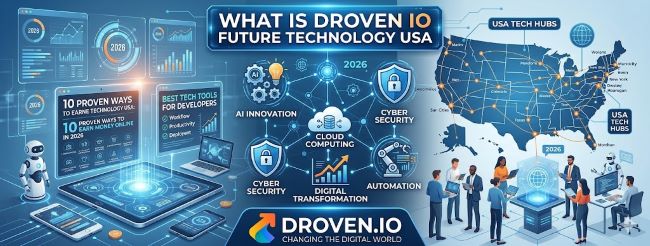
Droven.io is a technology-focused informational platform that covers AI, automation, cloud computing, and cybersecurity. The cybersecurity section — what most people refer to when they search for droven IO cybersecurity updates — publishes educational content on emerging threats, protection frameworks, and digital safety practices aimed at both technical and non-technical readers.
The platform draws on established industry sources including guidance from NIST, CISA, OWASP, and IBM Security to keep its content accurate and grounded. Rather than pushing specific software products, the focus is on awareness and understanding. Think of it as having a cybersecurity translator on call — one that reads the dense threat intelligence reports so you do not have to.
Droven IO cybersecurity updates cover four main areas: threat detection and awareness, zero trust architecture, cloud security, and AI-powered defense systems. Each of these areas maps to real, current challenges that organizations and individuals face in 2026.
The Current Threat Landscape
Before getting into defense strategies, it helps to understand what droven IO cybersecurity updates are responding to. The threat environment in 2026 is more complex than it was two years ago, and the pace of change is not slowing down.
AI-Powered Attacks
Artificial intelligence has changed cybercrime in a fundamental way. Attackers now use AI to automate the discovery of vulnerabilities, generate convincing phishing content at scale, and create deepfake audio and video for social engineering attacks. These are no longer theoretical risks — they are active attack methods.
AI-powered phishing is particularly effective because it removes the spelling errors and awkward phrasing that used to signal a scam. A well-crafted AI-generated email can be nearly indistinguishable from a legitimate message from a known contact or institution.
Ransomware Evolution
Ransomware has evolved well past the simple “encrypt files and demand payment” model. The current standard is triple extortion: attackers encrypt files, steal data, and then threaten to release it publicly or report regulatory violations if payment is not made. The average cost of a ransomware recovery now sits at $2.73 million, with healthcare breaches averaging $7.42 million.
Ransomware-as-a-Service (RaaS) platforms have lowered the barrier to entry for attackers, meaning even low-skill criminals can now launch effective campaigns by renting ready-made tools. This is why ransomware volume has continued to climb despite law enforcement pressure.
Supply Chain Attacks
Nearly 29% of breaches now involve third-party compromises. A single vulnerable vendor can expose thousands of downstream customers simultaneously. This is one of the fastest-growing attack vectors because most organizations have strong perimeter defenses but weaker controls over what their suppliers and partners can access.
The Financial Reality
IBM’s 2025 threat intelligence data put the average cost of a data breach at $4.88 million globally. Breaches take an average of 287 days to identify and contain — meaning most organizations are living with an active breach for nearly ten months before they know it happened. These numbers apply at scale, but the principle holds for organizations of any size: the cost of a breach far exceeds the cost of prevention.
Global cybercrime costs $10.5 trillion annually. That figure puts cybercrime on par with the GDP of major economies, and it keeps rising.
What Droven IO Cybersecurity Updates Cover: Key Defense Areas
Zero Trust Architecture
Zero trust is the security framework most consistently highlighted in droven IO cybersecurity updates, and for good reason. The core principle is simple: never trust, always verify. No user or device is automatically trusted based on network location. Every access request is verified continuously, and permissions follow least-privilege principles.
This matters because traditional perimeter-based security assumes that anything inside the network is safe. That assumption collapsed as remote work, cloud services, and mobile devices blurred the network edge. Zero trust rebuilds security around identity and context rather than location.
Gartner projects that organizations adopting Continuous Exposure Management — a framework closely aligned with zero trust principles — will be three times less likely to experience a breach by 2026 compared to those relying on static defenses.
Implementing zero trust does not require replacing all existing infrastructure at once. The practical starting points are multi-factor authentication (MFA), identity governance, and micro-segmentation — breaking networks into smaller zones so that a breach in one area cannot move freely through the entire system.
AI-Driven Threat Detection
The same AI capabilities that attackers are using can be deployed defensively. AI-powered threat detection systems monitor user behavior, network traffic, and system activity to identify anomalies in real time. When something unusual happens — a login from an unexpected location, a large data transfer outside normal hours, access to files an account has never touched before — the system flags it immediately rather than waiting for a human analyst to notice.
Autonomous Security Operations Centers (SOCs) now handle tier-one analyst work automatically: monitoring alerts, filtering false positives, investigating threats, and executing initial responses without human input. This matters because the cybersecurity skills gap is real — there are not enough qualified analysts to manually review the volume of alerts modern organizations generate.
IBM research shows that AI-powered security significantly reduces mean time to detect (MTTD) and mean time to respond (MTTR) compared to manual processes. Proactive AI security approaches deliver roughly 400% ROI through faster detection, reduced analyst burnout, and lower regulatory penalties.
Cloud Security
As organizations move more infrastructure to the cloud, the attack surface grows. Droven IO cybersecurity updates cover cloud security as a distinct discipline because cloud environments introduce risks that on-premises security models were not designed to handle.
The main cloud security priorities are: securing identity and access management (IAM) configurations, monitoring for misconfigured storage buckets and permissions, encrypting data in transit and at rest, and maintaining visibility across multi-cloud environments. Misconfigurations are the leading cause of cloud data exposure — not sophisticated attacks. Most cloud breaches trace back to permissions that were set too broadly or never reviewed after initial setup.
Credential and Identity Protection
Credential theft remains one of the most common attack entry points. Phishing, credential stuffing, and password spraying all target the same weakness: passwords. Passwordless authentication — using biometrics, hardware security keys, or decentralized identity systems — removes this attack surface entirely.
Where passwordless is not yet implemented, adaptive MFA provides the next best layer. Rather than applying the same authentication requirement to every login, adaptive MFA evaluates context: location, device, time of day, and behavior patterns. If something looks off, it asks for additional verification. If the login matches normal patterns, it stays frictionless.
Practical Steps Anyone Can Take
Droven IO cybersecurity updates are not just for enterprise security teams. The guidance applies at the individual and small business level too.
Enable MFA on every account that supports it. This one step blocks the majority of credential-based attacks. Use an authenticator app rather than SMS where possible.
Keep software and firmware updated. Most successful attacks exploit known vulnerabilities that already have patches available. Delayed updates are one of the most preventable sources of exposure.
Review cloud storage permissions. If you use Google Drive, Dropbox, or any cloud storage service, audit what is shared and with whom. Remove access that is no longer needed.
Train for phishing awareness. AI-generated phishing is convincing, but a few consistent habits — checking sender addresses, not clicking links in unexpected emails, verifying requests through a second channel — catch most attacks before they succeed.
Back up critical data offline. Ransomware cannot encrypt what it cannot reach. A clean offline backup is the most reliable recovery option when an attack succeeds.
Key Takeaways
- Droven IO cybersecurity updates are educational resources that translate complex cybersecurity topics into practical guidance for businesses, professionals, and individuals.
- The platform covers four main areas: threat intelligence and awareness, zero trust architecture, cloud security, and AI-powered defense systems.
- AI-powered attacks are now standard — attackers use machine learning to automate phishing, find vulnerabilities, and generate deepfakes for social engineering at scale.
- Ransomware has evolved to triple extortion: encrypting files, stealing data, and threatening public release or regulatory reporting. Average recovery costs $2.73 million.
- Supply chain attacks account for nearly 29% of breaches — one compromised vendor can expose thousands of customers simultaneously.
- The average cost of a data breach globally reached $4.88 million in 2025, with most breaches taking nearly ten months to detect.
- Zero trust architecture — verify every access request, trust nothing by default — is the security framework most recommended across droven IO cybersecurity updates for 2026.
- AI-driven threat detection reduces response time significantly compared to manual monitoring and delivers roughly 400% ROI in proactive security programs.
- Cloud misconfiguration, not sophisticated hacking, is the leading cause of cloud data exposure. Regular permission audits are one of the highest-impact prevention steps.
- Practical individual steps — MFA on every account, regular software updates, phishing awareness, and offline backups — address the majority of common attack vectors without enterprise-level resources.