This article is for informational purposes only. Always consult your pediatrician with specific questions about your baby’s sleep safety and readiness.
Every new parent gets at least a few beautiful baby blankets as gifts. Soft knitted throws, muslin swaddles, cozy quilts — they arrive wrapped in tissue paper and look perfect draped over a crib rail. Then the question hits: when can the baby actually sleep with one?
It is one of the most common questions pediatricians and sleep consultants hear, and the answer matters more than most parents initially realize. Knowing when can baby sleep with blanket comes down to understanding two things clearly: what the safety guidelines say, and what your baby’s physical development needs to look like before a blanket becomes appropriate.
The Short Answer: Not Before 12 Months
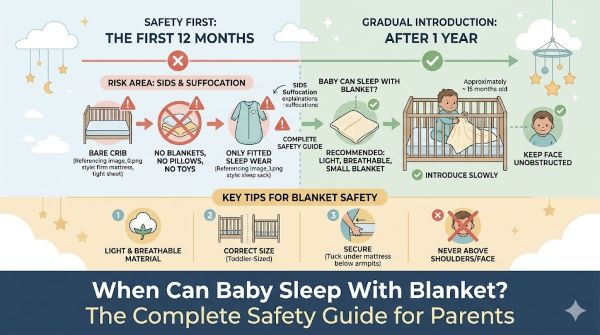
The American Academy of Pediatrics (AAP) is clear on this point. Babies under 12 months of age should not sleep with a blanket, pillow, stuffed animal, crib bumper, or any other loose soft object. The sleep space should contain only a firm, flat mattress with a tightly fitted sheet — and nothing else.
This is not an overly cautious recommendation. It is based on decades of research into sudden infant death syndrome (SIDS) and accidental suffocation, which together represent the leading causes of infant death in the first year of life. Loose bedding, including a baby blanket, can shift during sleep and cover a young baby’s face. Before 12 months, most babies do not have the motor strength or reflexes to move it away reliably — which is precisely what makes it dangerous.
The risk is highest in the first six months of life, but the AAP extends the guidance to the full first year because development varies between babies and the stakes are too high to guess.
Why 12 Months? Understanding the Developmental Reason
The 12-month guideline is not arbitrary. It reflects a genuine developmental shift in what babies can do physically.
Before 12 months, most babies cannot consistently roll both ways, push objects away from their face, reposition themselves when something obstructs their breathing, or regulate their own body temperature reliably. A blanket that shifts during sleep creates a risk that a young infant simply cannot manage.
After 12 months, most babies have developed the motor skills that change this picture. They can roll in both directions, sit up independently, pull to stand, and — most importantly — move their head and hands purposefully away from an obstruction. Their airway protection reflexes are stronger. Their ability to sense and respond to breathing difficulty has improved.
Think of blanket readiness less as a date on the calendar and more as a set of physical skills. The 12-to-18-month window is typical because this is when mobility and airway protection improve dramatically, but the specific timing varies between individual babies.
When Can Babies Start Sleeping With Blankets: Signs of Readiness
The minimum age is 12 months, but age alone is not the only signal. When can babies start sleeping with blankets safely also depends on what your baby can actually do.
Signs your baby may be ready for a blanket:
- Rolls confidently in both directions during sleep
- Sits up independently and pulls to stand in the crib
- Moves objects away from their face with consistent control
- Does not tend to burrow under soft items during sleep
Signs it is better to wait a little longer, regardless of age:
- Still a very still sleeper who does not reposition during the night
- Has not yet mastered rolling both ways reliably
- Tends to bury their face in soft objects rather than moving away from them
If your baby is 12 months old but still sleeping very still and not yet rolling confidently, waiting until 15 or 18 months is the safer call. Most pediatric experts, including HALO Sleep, recommend waiting ideally closer to 18 months if there is any doubt.
Safe Alternatives for the First Year
The most common concern parents have during the first year is that their baby will be cold without a blanket. This is a real and valid concern — but the solution is not a loose blanket. It is choosing the right sleepwear.
Sleep sacks (wearable blankets) are the standard safe alternative to loose blankets. They zip or snap around the baby’s body, staying in place through the night regardless of movement. There is no loose fabric to shift, bunch, or cover the baby’s face. Sleep sacks come in TOG-rated options to match every room temperature, from lightweight summer versions to warmer winter options.
Swaddling is appropriate for newborns and young babies who are not yet rolling. A properly swaddled baby is warm and settled without any loose fabric in the sleep space. The key safety rule: stop swaddling as soon as your baby shows signs of rolling, typically around two to four months. A swaddled baby who rolls onto their stomach cannot push back up, which creates a different safety risk.
Layered sleepwear — a cotton onesie under a footed sleeper, adjusted to room temperature — keeps most babies comfortable through the night without any added covering.
The room temperature itself matters too. Keeping the nursery between 68 and 72 degrees Fahrenheit (20 to 22 degrees Celsius) removes most of the concern about warmth. A baby in appropriate sleepwear in a properly heated room does not need a blanket to stay comfortable.
When Can Babies Sleep With a Blanket: How to Introduce It Safely
Once your baby passes 12 months and shows the physical readiness signs above, here is how to introduce a baby blanket gradually and safely.
Start during naps, not overnight. Introduce the blanket for supervised daytime naps first. Watch how your baby interacts with it during sleep — do they move it around, or does it stay in place? Do they seem comfortable, or do they get tangled?
Choose the right blanket. A lightweight, breathable blanket in natural fiber — cotton, muslin, or bamboo — is the right starting point. Avoid quilts, heavy knitted blankets, or anything oversized. The blanket should be small enough that it cannot wrap around your baby’s neck and thin enough that it does not trap heat.
Position it at chest level. Tuck the blanket under the mattress lightly so it sits no higher than your baby’s chest with their arms free above it. Placing your baby with their feet at the bottom of the crib means that if they wriggle during sleep, they move upward — away from the blanket rather than further under it.
Keep the crib simple. Even after 12 months, a mostly empty sleep space is still the safest sleep space. One lightweight blanket is appropriate. Multiple blankets, pillows, or stuffed animals are not.
Watch for overheating. A blanket adds warmth. If you add a baby blanket, reduce the layers underneath accordingly. Check your baby’s chest or the back of their neck after twenty to thirty minutes — warm but not sweaty is what you are looking for.
Choosing the Right Baby Blanket
When the time comes to introduce a blanket, the type matters as much as the timing.
Material: Natural, breathable fabrics are the safest choice. Organic cotton, muslin, and bamboo all allow air circulation and reduce the risk of overheating. Avoid synthetic fabrics that trap heat, and avoid heavy or bulky options like thick quilts or weighted blankets.
Size: A blanket sized for a toddler, not a child’s bed or adult bed. Too large means too much loose fabric. A blanket your baby can eventually pull up themselves without bunching is the right scale.
Construction: Avoid blankets with loose threads, decorative holes that fingers can get caught in, or embellishments that could detach. A simple, flat-knit or woven cotton blanket with no decorative elements is the safest option.
Weight: Light is always safer than heavy. If you are unsure, choose lighter. You can always add a layer of clothing underneath if the room is cool rather than adding a heavier blanket on top.
What About Weighted Blankets?
Weighted blankets are not appropriate for babies or toddlers. Current AAP and safety guidelines specifically flag weighted sleep products as unsafe for infants and young children. The added weight can restrict chest expansion and affect breathing. Avoid weighted blankets, weighted sleep sacks, and weighted swaddles regardless of the marketing claims attached to them.
When Can Babies Sleep With a Blanket: By Age Summary
0 to 12 months: No loose blankets of any kind. Use a sleep sack matched to room temperature, appropriate sleepwear layers, and a properly temperature-controlled nursery.
12 to 18 months: A lightweight, breathable baby blanket may be introduced once your baby shows clear physical readiness signs. Start with supervised naps and position it at chest level.
18 months and beyond: Most toddlers can use a lightweight blanket comfortably at this stage. Many families continue using toddler sleep sacks past 18 months — there is no reason to stop if the sleep sack is still working well.
2 years and beyond: By age two, most toddlers have the motor skills to manage a blanket independently during sleep. Note that most children cannot reliably replace a blanket themselves if it falls off during the night until around age two and a half to four — so a toddler sleep sack remains a practical option well past the first birthday.
Key Takeaways
- When can baby sleep with blanket? Not before 12 months. The AAP recommends keeping all loose soft objects, including blankets, pillows, and stuffed animals, out of a baby’s sleep space for the entire first year.
- SIDS risk is highest in the first six months but the blanket restriction extends to 12 months because babies develop at different rates and the risk does not disappear overnight at the six-month mark.
- Blanket readiness is about physical development, not just age. Your baby should be rolling confidently in both directions, repositioning during sleep, and able to move objects away from their face before a blanket is introduced.
- Most pediatric experts recommend waiting until 12 to 18 months, and ideally closer to 18 months if there is any doubt about your baby’s physical readiness.
- Sleep sacks are the safest alternative to a baby blanket during the first year — they provide warmth without any loose fabric and come in TOG ratings to suit every room temperature.
- When introducing a baby blanket after 12 months, start with supervised naps rather than overnight sleep, and observe how your baby interacts with it before making it a permanent part of the sleep routine.
- Choose a lightweight, breathable blanket in natural fiber — cotton, muslin, or bamboo. Avoid quilts, heavy knits, oversized blankets, and anything with loose threads or decorative embellishments.
- Position the blanket at chest level with your baby’s feet at the bottom of the crib. Tuck it lightly under the mattress so it cannot shift upward during sleep.
- Weighted blankets are not appropriate for babies or toddlers at any age — current safety guidelines are clear that weighted sleep products carry breathing risks for young children.
- When can babies sleep with blankets and keep themselves covered? Most children cannot replace a blanket independently during the night until around age two and a half to four — a toddler sleep sack remains a practical option long past the first birthday.