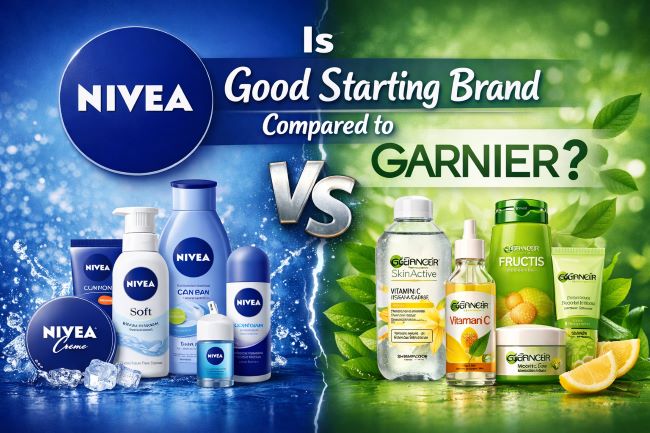
Standing in the skincare aisle for the first time is genuinely overwhelming. There are dozens of products, hundreds of claims, and no obvious starting point. Most beginners end up grabbing the first thing they recognize — and for millions of people, that’s either a blue Nivea tin or a green Garnier tube.
Both are solid starting brands. But they are not the same. They serve different skin concerns, use different ingredients, and are built around different priorities. This guide breaks down the real differences between Nivea and Garnier for beginners — without the complicated ingredient jargon that makes most skincare guides hard to follow.
The Short Answer
Yes, Nivea is a good starting brand for skincare beginners — especially if you have dry, normal, or sensitive skin. Its products are simple, gentle, and low-risk, which is exactly what a first routine needs.
Garnier is also beginner-friendly, but it suits oily, combination, or acne-prone skin better. It offers more targeted products — salicylic acid cleansers, vitamin C serums, and micellar cleansers — which work well once you have a clearer idea of what your skin needs.
The most useful answer is not which brand wins overall. It’s which one matches your skin right now.
What Beginners Actually Need
Before comparing brands, it helps to understand what a first skincare routine should look like. Skincare marketing makes it feel like you need ten products minimum. In reality, a beginner routine needs exactly three things:
- A cleanser
- A moisturizer
- Sunscreen (SPF)
That’s it. Everything else — serums, toners, exfoliants, essences, eye creams — is optional and better added later, once your skin has settled into a basic routine. Starting too many active ingredients at once is one of the most common beginner mistakes, and it often causes irritation that gets misread as a skin problem.
Both Nivea and Garnier sell products across all three of these categories at very affordable prices, which is why they come up so often in beginner conversations.
Nivea for Beginners: What You Need to Know
Nivea has been making moisturizers for over a century, and that shows in how its products are built. The formulas are straightforward, the textures are rich and hydrating, and the ingredient lists are short by modern skincare standards.
The core Nivea moisturizers — the blue tin Creme, Nivea Soft, and the Q10 range — are built on glycerin, panthenol (Vitamin B5), mineral oil, Eucerit, and Vitamin E. These are three of the most well-tested hydrating ingredients in skincare. None of them are active ingredients that require careful introduction. None of them are likely to irritate a new user.
The simplest way to think about Nivea: it’s a moisturizing brand that happens to make other products. Everything points back toward hydration and skin barrier support.
Nivea works best for:
- Dry skin
- Normal skin
- Sensitive skin
- Beginners who want a simple, low-confusion routine
- Anyone who has never used a dedicated skincare routine before
Starter products to look for:
- Nivea Soft (light daily moisturizer, face and body)
- Nivea Creme (the blue tin — richer, better for very dry skin or hands)
- Nivea Micellar Water (gentle makeup removal and cleansing)
Potential downsides:
- Less useful for oily or acne-prone skin
- Fewer targeted treatment options
- Some products contain mild fragrance, which can irritate very reactive skin
Garnier for Beginners: What You Need to Know
Garnier takes a more modern and active-focused approach. The brand is especially popular for its Micellar Water, its vitamin C brightening line, and its salicylic acid products for oily and acne-prone skin. Garnier products often target a specific skin concern rather than general daily hydration.
Garnier’s Vitamin C Bright Complex, Hyaluronic Aloe moisturizer, and 2% Salicylic Acid cleanser are noticeably more active-led than anything in Nivea’s main catalogue. These are effective products, but they require a bit more care when you are just starting out — particularly if you are not yet sure how your skin reacts to actives.
Garnier’s Micellar Water is a genuine exception to this. It is widely recommended as a beginner cleanser — gentle, no-rinse, and effective at removing makeup and daily grime without harsh surfactants. Reddit’s r/SkincareAddiction community consistently recommends it as one of the most accessible first cleansers on the market.
Garnier works best for:
- Oily skin
- Combination skin
- Acne-prone skin
- Beginners who want to address dullness or uneven tone early on
- Teenagers and younger users dealing with excess oil
Starter products to look for:
- Garnier Micellar Cleansing Water (any version — pink for sensitive, blue for waterproof makeup)
- Garnier Aloe Vera Moisturizer (lightweight, good for oily or combination skin)
- Garnier Vitamin C Serum (once you are ready to add a targeted product)
Potential downsides:
- Active ingredients like salicylic acid and vitamin C can irritate beginners who overuse them
- Wider product range can overwhelm newcomers who don’t know what they need
- Some users report tightness after certain Garnier formulas
Nivea vs Garnier: Side-by-Side Comparison
| Category | Nivea | Garnier |
|---|---|---|
| Best for | Dry, normal, sensitive skin | Oily, combination, acne-prone skin |
| Skincare philosophy | Hydration and barrier support | Targeted solutions and active ingredients |
| Ingredient complexity | Low — simple, classic formulas | Moderate to high — includes actives like salicylic acid, vitamin C |
| Best beginner product | Nivea Soft or Creme | Garnier Micellar Water |
| Risk of irritation | Low | Low to moderate depending on product |
| Price | Very affordable | Very affordable |
| Availability | Global — drugstores, supermarkets | Global — drugstores, supermarkets |
| Best first routine product | Moisturizer | Cleanser |
Which Brand Is Better for Your Skin Type?
Dry or normal skin: Start with Nivea. The Soft cream handles daily moisturizing without any actives to worry about. Pair it with a gentle cleanser and an SPF.
Sensitive skin: Nivea is the safer choice. Shorter ingredient lists, fewer potential irritants, and no strong actives reduce the risk of a reaction. Look for fragrance-free options in the Nivea Sensitive range.
Oily or combination skin: Garnier suits you better. The Hyaluronic Aloe moisturizer is lightweight enough not to feel heavy, and the Micellar Water gives you a clean start without stripping the skin.
Acne-prone skin: Garnier’s salicylic acid products help — but introduce them slowly, not all at once. Start with the Micellar Water for cleansing and add the salicylic acid cleanser separately once your skin has adjusted.
Dull or uneven skin tone: Garnier’s vitamin C line is designed for this. Worth adding once you have a basic routine in place for a few weeks.
Can You Mix Both Brands?
Yes — and many people do. Mixing brands is completely normal in skincare. A popular beginner combination is Garnier’s Micellar Water as a cleanser with Nivea Soft as the moisturizer. Each brand covers a different step in the routine, and the two work well together.
Once you have your three-step routine settled, you can slowly add targeted products from either brand — a Garnier vitamin C serum, a Nivea Q10 night cream — without restarting from scratch.
The One Thing Neither Brand Covers Well
Neither Nivea nor Garnier sells a strong daily SPF product in all markets. Sunscreen is non-negotiable in any beginner routine — it is the single most effective anti-ageing and skin-protection step you can take. Whichever brand you start with, add a separate SPF 30 or SPF 50 sunscreen to your morning routine. Most drugstores stock standalone sunscreens from brands like La Roche-Posay, Altruist, or Bondi Sands at affordable prices.
Key Takeaways
- Nivea is a good starting skincare brand for beginners, especially those with dry, normal, or sensitive skin — its formulas are simple, gentle, and low-risk, which is exactly what a first routine needs.
- Garnier is also beginner-friendly but works better for oily, combination, or acne-prone skin, thanks to its targeted active-ingredient products like salicylic acid cleansers and vitamin C serums.
- The simplest beginner routine needs only three products: a cleanser, a moisturizer, and a sunscreen — everything else can wait until your skin has settled.
- Nivea’s core products (Soft, Creme, Q10) use glycerin, panthenol, and mineral oil — well-tested, gentle hydrators with a very low risk of irritation for new skin.
- Garnier’s Micellar Water is the brand’s most universally recommended beginner product — gentle, effective, no rinsing required, and consistently praised in skincare communities like Reddit’s r/SkincareAddiction.
- Starting too many active ingredients at once is the most common beginner mistake — Nivea’s simpler range makes this easier to avoid, while Garnier requires a bit more attention to which product you pick first.
- You can mix both brands in one routine — a common pairing is Garnier Micellar Water as a cleanser with Nivea Soft as a moisturizer.
- Neither brand sells a reliable standalone sunscreen in all markets — add a separate SPF 30 or SPF 50 sunscreen to any beginner routine regardless of which brand you choose.
- Both brands are available at very similar prices in most drugstores and supermarkets worldwide, so cost is not a deciding factor between the two.
- The real driver of skin improvement at the beginner stage is consistency — a simple two or three-product routine used every day for six weeks will do more than an expensive ten-step routine used twice.