The morning coffee decision goes beyond beans and roasts. Your brewing method shapes the entire cup. The two heavy hitters in home brewing are the French press and the pour-over. Both deliver great coffee, but they go about it in very different ways. One is forgiving. One rewards precision. One creates bold, oily cups. One produces bright, clean ones. This guide compares them side by side so you can pick the method that fits your mornings and your taste.
How French Press and Pour-Over Work
Understanding how each method brews will help explain why they taste so different and why one might feel easier than the other.
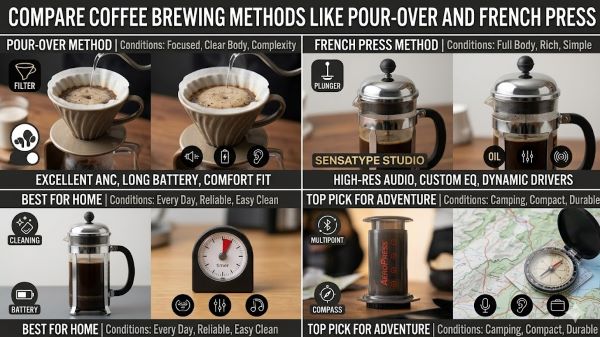
A French press uses immersion brewing. You add coarse grounds and hot water to the same vessel, let them sit together for about four minutes, then press a metal plunger down to separate the grounds from the liquid. During that whole four minutes, the grounds stay submerged in the water. Every part of the coffee steeps and extracts at once. Nothing filters out the oils, so they end up in your cup, giving French press coffee its signature rich, heavy body and buttery mouthfeel.
Pour-over uses percolation brewing. Grounds sit in a paper or metal filter inside a dripper, and you pour hot water over them in a slow, controlled way. Gravity pulls the water down through the grounds and the filter into a cup or carafe below. The paper filter traps oils and fine particles as the water passes through, so the result is cleaner and lighter. The process takes about three minutes, and your technique matters. How fast you pour, how even you saturate the grounds, and the timing all shape the final cup.
These two methods extract coffee in fundamentally different ways, which is why they produce such different results in the cup.
Taste: Bold and Full vs Clean and Bright
The biggest difference you will notice is the flavor profile and mouthfeel.
French press coffee is bold and heavy. The metal mesh filter lets all the natural oils through, and those oils carry aromatic compounds. They create a thick, almost buttery feeling on your tongue. The coffee tastes intense and earthy, with robust flavors that announce themselves. If you love a strong, rich cup with character, this is your method.
Pour-over coffee is clean and bright. The paper filter catches the oils and sediment that the French press lets through. Without that heaviness, the coffee feels lighter on your tongue and lets you taste subtle flavor notes. Pour-over shines with lighter roasts, where the coffee’s fruity and floral notes come through. The cup is crisper and more refreshing. If you like clarity and want to taste what your beans actually are, this is the method.
Neither profile is objectively better. The choice comes down to whether you want bold and full or clean and bright.
Which Method Is Easier to Make?
This is where the brewing methods split most clearly. For ease, the French press wins.
Making French press coffee is almost foolproof. You scoop coarse grounds into the carafe, pour hot water to a certain level, stir once, and wait four minutes. Then you push the plunger down and pour. There is no technique to master. The timing is forgiving. You can drift a bit on the water-to-coffee ratio and still get a good cup. Most people get a decent result on their first try.
Pour-over has a learning curve. Your success depends on several moving parts. You need the right water temperature, around 200 degrees Fahrenheit or just under boiling. You need the right grind size, which is medium-fine and different from French press grounds. You need to pour in a controlled way, often in a circular pattern to wet the grounds evenly. You need a gooseneck kettle so you can pour at a steady rate. If you rush any of these steps or skip one, the cup suffers. Pour-over rewards practice and attention, but beginners often struggle at first.
For simplicity, the French press is the clear winner. It forgives mistakes. Pour-over demands precision.
Grind Size and Water-to-Coffee Ratio
Each method needs a different grind.
French press requires a coarse grind, similar to sea salt. The larger pieces steep in the water without over-extracting. If your grind is too fine, the coffee will taste bitter and gritty.
Pour-over needs a medium-fine grind, smaller than French press but not powder-fine. The right size lets water pass through at the right speed. Too coarse and the water flows through too fast, leaving the coffee under-extracted and sour. Too fine and it blocks the water, over-extracting the coffee and making it bitter.
The water-to-coffee ratio is similar for both. Most people start with one part coffee to fifteen or sixteen parts water, then adjust to taste. French press is more forgiving about small variations. Pour-over punishes carelessness about ratios, since the filter and your pour technique interact with the ratio in ways that take practice to control.
Cleanup: Where Pour-Over Shines
Cleanup is not the most exciting topic, but it shapes whether you stick with a method long-term.
Pour-over cleanup is fast and easy. Once brewing finishes, you lift out the paper filter with the spent grounds and toss it into the trash or compost. Rinse the dripper under the tap, and you are done. The whole process takes about 15 to 30 seconds. There are no moving parts to disassemble or oils to scrub away.
French press cleanup is more work. You have to scoop the wet, sludgy grounds out of the carafe into the trash. Never pour them down the sink, since they can clog your pipes. Then you have to take apart the plunger and mesh filter, rinse each piece, and scrub the mesh to remove oils and sediment. If you do not clean it well, oils can go rancid between uses. The whole task takes one to two minutes.
For anyone who values a quick morning routine, this is a big point in pour-over’s favor.
Cost: French Press Gets the Edge
Both methods are budget-friendly, but the total cost matters if you are deciding which to buy.
A basic French press costs $20 to $40. It is a simple glass carafe with a metal plunger, and you can use any kettle you already own. The equipment is minimal.
Pour-over looks cheaper at first. A ceramic or plastic dripper might cost $10 to $30. But pour-over truly shines with a gooseneck kettle, which lets you pour at a steady, controlled rate. A good gooseneck kettle costs $30 to $60. Add in the ongoing cost of paper filters, and pour-over ends up more expensive over time. Plus, many people find that investing in a scale and a good burr grinder makes pour-over worth the cost by improving consistency.
If you are new to manual brewing and want to start cheap, the French press has a lower barrier to entry. With pour-over, a gooseneck kettle is almost essential, which bumps the starting cost.
Brewing Time and Convenience
French press takes about four to five minutes from start to pour. You prep the grounds, add water, wait, and press.
Pour-over takes about three minutes of active brewing, but the process requires your attention the whole time. You cannot walk away and let it brew. You are pouring in stages, paying attention to saturation and timing.
If you want to set it and forget it, French press is more convenient. If you enjoy the ritual and do not mind tending to your brew, pour-over can feel less like a chore and more like meditation.
Which Method Works for Multiple Cups?
French press scales well. A 34-ounce press makes about three cups at once, and larger sizes go up to 51 ounces for a full household. You make one batch and pour for everyone.
Pour-over is designed for single cups or small batches. You can pour-over for multiple cups in sequence, but it takes longer and requires repeating the process. If you are brewing for a family, French press is the clear winner for efficiency.
Sediment and Grit
This matters if you dislike sludge in your cup.
French press almost always leaves a fine layer of sediment and oil at the bottom of the cup, especially if the mesh is not new. Some people love this texture. Others find it gritty and unpleasant. The sediment is mostly harmless, but it changes the mouthfeel.
Pour-over eliminates sediment because the paper filter catches it. The result is a cleaner cup with no grit. If you hate the texture of sediment, pour-over is the better choice.
Environmental Impact
Pour-over uses disposable paper filters, which end up in the trash or compost after each brew. Multiply that by daily use, and you create a steady stream of paper waste over the year.
French press uses a reusable metal mesh filter. Once you buy the press, there is no filter waste. From an environmental view, French press is the greener option. If you care about sustainability, this tip the scales toward French press.
The Verdict: Which One Is Easier?
For pure ease of making the coffee, the French press wins. It is forgiving, fast, and requires no specialized technique. For beginners, start here.
For cleanup and clarity, pour-over wins. If you do not mind learning a skill and do not mind the slightly higher cost, pour-over rewards you with a cleaner cup and a quicker cleanup.
For convenience if you are brewing for multiple people, French press is the only choice. For budget-conscious entry into manual brewing, French press is the path.
The best method is the one that matches your morning habits, your taste, and your willingness to invest time or money. Many coffee lovers end up keeping both and picking based on mood or time available. You might go French press on rushed mornings and pour-over on weekend when you have time to slow down.
Step-by-Step: Making French Press Coffee
If you are ready to try the method that takes just four minutes, here is the process.
Heat water to about 200 degrees Fahrenheit, just under boiling. Add coarse grounds to the carafe using a ratio of one part coffee to fifteen or sixteen parts water. Pour a small amount of hot water first to wet the grounds, then pour the rest. Stir once to ensure everything mixes. Place the lid on top without pressing the plunger down. Wait four minutes. Press the plunger down slowly and evenly. Pour into your cup right away before the grounds settle again.
Step-by-Step: Making Pour-Over Coffee
If you want to try the method that rewards attention, here is the process.
Heat water to about 200 degrees Fahrenheit. Place a paper filter in the dripper and rinse it with hot water to remove the paper taste. Add medium-fine grounds to the filter. Pour a small amount of water to bloom the grounds for about 30 seconds. Pour the rest of the water in slow circles, keeping the grounds wet but not submerged. The total brew time is about two and a half to three minutes. Pour into your cup and enjoy.
Key Takeaways
- Compare coffee brewing methods by understanding that French press uses immersion and metal filters for bold, oil-forward coffee, while pour-over uses percolation and paper filters for clean, bright coffee.
- French press is easier to make for beginners, with a forgiving process that requires no special technique and takes about four minutes from start to pour.
- Pour-over requires more precision and practice, with success depending on water temperature, grind size, pouring technique, and attention throughout the three-minute brew.
- French press coffee has a heavy body, rich mouthfeel, and earthy flavors from natural oils that pass through the metal mesh filter.
- Pour-over coffee is clean and bright, highlighting subtle fruity and floral notes, with a lighter body because the paper filter removes oils and sediment.
- Cleanup is much easier with pour-over, taking about 15 to 30 seconds compared to one to two minutes for the French press.
- French press has a lower entry cost at $20 to $40, while pour-over requires a gooseneck kettle for best results, pushing the total cost to $40 to $90 or more.
- French press scales well for making multiple cups at once, while pour-over is designed for single cups or small batches.
- French press almost always leaves some sediment in the cup, while pour-over produces a completely clean cup with no grit.
- French press uses a reusable metal filter, making it the greener choice, while pour-over uses disposable paper filters that create waste over time.
- Many coffee lovers keep both brewers and choose based on their morning mood, time available, and what flavor they want that day.