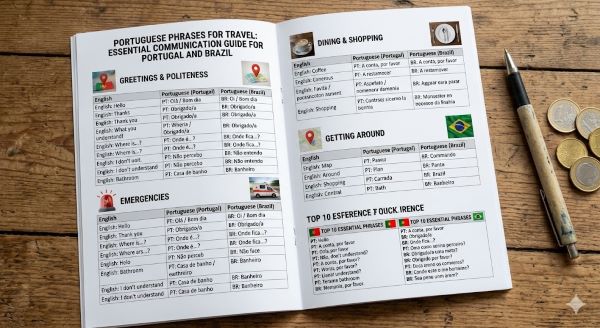
Learning Portuguese phrases for travel transforms your ability to navigate, connect with locals, and experience destinations in Portugal, Brazil, and Portuguese-speaking countries authentically. Portuguese phrases for travel range from basic greetings and politeness to practical requests for directions, food ordering, and emergency communication. Whether you are visiting Lisbon’s narrow streets, Rio de Janeiro’s beaches, or exploring the Portuguese interior, having essential Portuguese phrases for travel in your vocabulary dramatically improves your experience and demonstrates respect for local culture. This guide covers the most useful Portuguese phrases for travel across common scenarios you will encounter.
Greetings and Politeness: Essential Portuguese Phrases for Travel
Starting interactions with appropriate greetings establishes rapport and sets a positive tone for Portuguese phrases for travel.
Olá (OH-lah) means “hello” and is the standard greeting. This simple Portuguese phrases for travel foundation appears in nearly every interaction with locals.
Bom dia (bom DEE-uh) means “good morning” and is used until roughly noon. Using time-appropriate greetings demonstrates cultural awareness, making Portuguese phrases for travel more respectful.
Boa tarde (BOA TAR-duh) means “good afternoon” and applies from noon until evening. This Portuguese phrases for travel distinction shows attentiveness to local customs.
Boa noite (BOA NOY-tuh) means “good evening” or “good night” and is used after dusk. These time-based Portuguese phrases for travel reflect Portuguese culture’s attention to formality and respect.
Obrigado (oh-bree-GAH-doo) means “thank you” (male speaker) while obrigada (oh-bree-GAH-duh) is the female form. Using the correct gender form in Portuguese phrases for travel shows linguistic attention, though either form is understood regardless of speaker gender.
De nada (duh NAH-duh) means “you’re welcome,” a natural response to gratitude in Portuguese phrases for travel conversations.
Por favor (por fuh-VOR) means “please” and appears in most polite Portuguese phrases for travel requesting assistance or ordering.
Desculpe (desh-KOO-puh) means “excuse me” or “sorry,” useful Portuguese phrases for travel for getting attention or apologizing for minor infractions.
Tudo bem? (TOO-doo bem) means “How are you?” or literally “Is everything well?” This casual Portuguese phrases for travel greeting opens conversations naturally.
Ordering Food: Portuguese Phrases for Travel in Restaurants
Food is central to travel experiences, making Portuguese phrases for travel related to dining essential.
Eu gostaria de… (eh-oo gosh-tuh-REE-uh duh) means “I would like…” and is the polite foundation for Portuguese phrases for travel ordering. Follow with the food name: “Eu gostaria de um café” (I would like a coffee).
A conta, por favor (uh KON-tuh, por fuh-VOR) means “the bill, please,” essential Portuguese phrases for travel for concluding meals.
Qual é a especialidade? (kwal eh uh esh-puh-see-uh-LI-duh-duh) means “What is the specialty?” helping you discover popular Portuguese phrases for travel dining that locals recommend.
Vegetariano/Vegetariana (veh-juh-tuh-ree-AH-no/nuh) indicates vegetarian preferences in Portuguese phrases for travel, useful for dietary requests.
Sem açúcar (sem uh-SOO-kar) means “without sugar,” important Portuguese phrases for travel for coffee or beverage customization.
Água com gás / Água sem gás (AH-gwuh com gash / AH-gwuh sem gash) means “sparkling water / still water,” common Portuguese phrases for travel for drink ordering.
Quanto custa? (KWAN-too KOOS-tuh) means “How much does it cost?” a foundational Portuguese phrases for travel for pricing inquiries.
Delicioso! (duh-lee-see-OH-zoo) means “Delicious!” expressing satisfaction with Portuguese phrases for travel dining experiences.
Asking Directions: Portuguese Phrases for Travel Navigation
Navigating unfamiliar areas requires Portuguese phrases for travel that request and clarify directions.
Onde fica…? (ON-duh FEE-kuh) means “Where is…?” and is the fundamental Portuguese phrases for travel for location questions. Follow with a destination: “Onde fica a estação de comboios?” (Where is the train station?).
Estou perdido/perdida (esh-TOH pair-DEE-doo/duh) means “I am lost” (male/female), honest Portuguese phrases for travel that often elicits helpful responses from locals.
À esquerda (ah esh-QUER-duh) means “to the left,” while à direita (ah dee-RAY-tuh) means “to the right,” crucial Portuguese phrases for travel for following directions.
Em frente (em FREN-tuh) means “straight ahead,” a common component of Portuguese phrases for travel directions.
Perto (PAIR-too) means “near,” while longe (LON-juh) means “far,” distance descriptors in Portuguese phrases for travel.
Virar (vee-RAR) means “to turn,” used in Portuguese phrases for travel like “vire à esquerda” (turn left).
A próxima rua (uh PROH-see-muh ROO-uh) means “the next street,” helping clarify Portuguese phrases for travel turn-by-turn directions.
Practical Requests: Portuguese Phrases for Travel Assistance
Beyond dining and directions, practical Portuguese phrases for travel cover common needs.
Falo um pouco de português (FAH-loo oom POH-koo duh por-too-GES) means “I speak a little Portuguese,” honest Portuguese phrases for travel that sets realistic communication expectations and usually generates patience from locals.
Fala inglês? (FAH-luh in-GLESH) means “Do you speak English?” useful Portuguese phrases for travel when language barriers emerge.
Pode ajudar-me? (POH-duh uh-zhoo-DAR-muh) means “Can you help me?” a direct Portuguese phrases for travel appeal for assistance.
Onde é o banheiro? (ON-duh eh oo buh-nyAY-roo) means “Where is the bathroom?” perhaps the most practical Portuguese phrases for travel.
Quanto tempo leva? (KWAN-too TEM-poo LEH-vuh) means “How long does it take?” useful Portuguese phrases for travel for transit planning.
Que horas é? (kuh O-rash eh) means “What time is it?” essential Portuguese phrases for travel for schedule management.
Amanhã (uh-mun-YAH) means “tomorrow,” while hoje (OH-zhuh) means “today,” time references in Portuguese phrases for travel.
Numbers and Prices: Portuguese Phrases for Travel Commerce
Understanding numbers and prices constitutes essential Portuguese phrases for travel.
Um, dois, três, quatro, cinco, seis, sete, oito, nove, dez (oom, doysh, tresh, KWAR-too, SING-koo, says, SEH-tuh, OY-too, NOH-vuh, des) are the Portuguese phrases for travel numbers 1–10.
Vinte (VING-tuh) is 20, trinta (TRIN-tuh) is 30, quarenta (kwuh-REN-tuh) is 40, continuing patterns in Portuguese phrases for travel for higher numbers.
Cem (sem) is 100, mil (meel) is 1,000, um milhão (oom mee-LYOWN) is one million, useful Portuguese phrases for travel for large amounts and prices.
Custa… (KOOS-tuh) means “it costs…” introducing prices in Portuguese phrases for travel transactions.
Muito caro (MOO-ee-too KAH-roo) means “very expensive,” Portuguese phrases for travel for expressing price concerns.
Desconto (desh-KON-too) means “discount,” essential Portuguese phrases for travel for negotiating or inquiring about price reductions.
Emergency and Safety: Critical Portuguese Phrases for Travel
Knowing emergency Portuguese phrases for travel can be lifesaving.
Ajuda! (uh-ZOO-duh) means “Help!” the most urgent Portuguese phrases for travel.
Chama a polícia (SHAH-muh uh poo-LEE-see-uh) means “Call the police,” critical Portuguese phrases for travel in emergencies.
Preciso de um médico (pruh-SEE-zoo duh oom MEH-dee-koo) means “I need a doctor,” essential Portuguese phrases for travel for health emergencies.
Tenho uma alergia (TEN-yoo OO-muh uh-LER-zhee-uh) means “I have an allergy,” vital Portuguese phrases for travel related to medical conditions.
Documento (doo-koo-MEN-too) means “document” or “ID,” Portuguese phrases for travel for responding to identification requests.
Cultural Notes on Portuguese Phrases for Travel
Understanding cultural context enhances Portuguese phrases for travel effectiveness.
Brazilian Portuguese vs. European Portuguese pronunciation and vocabulary differ slightly, making some Portuguese phrases for travel sound different depending on region. Lisbon Portuguese uses softer consonants while Brazilian Portuguese is more direct, both understood across regions.
Formal vs. informal address matters in Portuguese phrases for travel. Using “você” (informal) or “o senhor/a senhora” (formal) reflects appropriate respect levels, important in Portuguese phrases for travel with older locals or service providers.
Diminutives are common in Portuguese phrases for travel and daily speech, adding “-inho” or “-inha” to words creates affectionate forms (café → cafezinho), a cultural feature that endears travelers using Portuguese phrases for travel.
Key Takeaways
- Learning Portuguese phrases for travel dramatically improves navigation, dining, and local connection in Portuguese-speaking countries.
- Basic greetings like “Olá,” “Bom dia,” “Obrigado,” and “Por favor” form the foundation of respectful Portuguese phrases for travel.
- Time-appropriate greetings including “Bom dia” (morning), “Boa tarde” (afternoon), and “Boa noite” (evening) demonstrate cultural awareness in Portuguese phrases for travel.
- Food-related Portuguese phrases for travel like “Eu gostaria de…” and “A conta, por favor” enable comfortable restaurant experiences.
- Direction requests using “Onde fica…?” and clarity phrases like “à esquerda” and “à direita” make navigation manageable.
- Practical phrases like “Estou perdido,” “Falo um pouco de português,” and “Pode ajudar-me?” build helpful interactions in Portuguese phrases for travel.
- Understanding numbers and prices from 1 to 1,000,000 supports commerce and negotiation in Portuguese phrases for travel.
- Emergency phrases including “Ajuda!,” “Chama a polícia,” and “Preciso de um médico” are critical knowledge for Portuguese phrases for travel.
- Brazilian and European Portuguese pronunciation differ slightly; both are understood across regions despite regional Portuguese phrases for travel variations.
- Formal address using “o senhor” and “a senhora” shows respect in Portuguese phrases for travel with service providers and elders.
- Diminutives like “-inho” and “-inha” are culturally common, adding affection to Portuguese phrases for travel.
- Practicing pronunciation of common Portuguese phrases for travel before arrival increases confidence and successful communication with locals.