You’re considering a career in real estate or looking to change jobs. Best paying jobs in real estate investment trusts keeps appearing in your searches. You wonder whether REIT careers pay well and whether pursuing this path makes sense for your future.
Real estate investment trusts (REITs) employ thousands of people in various roles. Understanding best paying jobs in real estate investment trusts and the career path helps you decide if this industry matches your goals.
Let’s talk about what REITs are, which jobs pay the most, and whether pursuing a REIT career makes sense.
Understanding Real Estate Investment Trusts
A REIT (Real Estate Investment Trust) is a company that owns, operates, or finances income-producing real estate.
REITs own different types of properties:
- Apartment buildings
- Office buildings
- Shopping centers
- Warehouses
- Hotels
- Data centers
- Hospitals
REITs must distribute at least 90% of taxable income to shareholders as dividends. This structure makes them attractive investments and sustains employment.
REIT real estate operations require diverse professionals. Management, analysis, operations, development, and finance roles exist across the industry.
Understanding REIT structure explains why certain jobs exist and why they pay what they do.
Is Real Estate Investment Trusts a Good Career Path
Is real estate investment trusts a good career path depends on your interests, skills, and goals.
Advantages of REIT careers:
Stable industry with consistent demand. People always need housing and commercial space.
Good salaries compared to many industries. We’ll detail specific positions.
Career progression opportunities. Start in junior roles, advance to senior management.
Diverse job types. Different interests find different roles.
Growth in REIT sector. More REITs operate now than in the past. More jobs exist.
Disadvantages:
Cyclical industry. Economic downturns reduce real estate values and REIT employment.
Specialized knowledge required. You need to understand real estate and finance.
Geographic limitations. Some positions require specific locations.
Market sensitivity. Your career depends on real estate market health.
For many people, REIT careers offer good stability and growth. But it’s not universally ideal.
How Many Jobs Are Available in Real Estate Investment Trusts
How many jobs are available in real estate investment trusts varies by year and economic conditions.
Large REITs employ hundreds. Mid-size REITs employ dozens to hundreds. Thousands of REITs exist, from tiny to massive.
The REIT industry employs tens of thousands nationwide. Job growth has been positive overall, especially in specialized REITs like data centers and logistics.
Finding available positions happens through:
- REIT career pages
- Real estate job boards
- General job sites
- Networking and referrals
Job availability fluctuates. During strong economic periods, many positions open. During downturns, fewer opportunities exist.
Are REITs a Good Investment (Understanding the Business)
Understanding are REITs a good investment helps you understand REIT business health and career stability.
REIT investment advantages:
High dividend yields. REITs distribute 90% of income, creating high dividends.
Real estate exposure. Investing in real estate without owning property.
Professional management. Full-time professionals manage properties.
Diversification. Different REIT types own different properties.
Disadvantages:
Interest rate sensitivity. Rising rates reduce REIT values.
Economic cycle impact. Recessions reduce property values and rents.
Interest expense. REITs borrow money, making interest costs high.
Market volatility. REIT stocks fluctuate like any stocks.
Whether REITs are good investments depends on market conditions and your goals. But from a career perspective, understanding investment dynamics helps you understand industry health.
Entry-Level REIT Positions
Starting careers in REITs often means entry-level roles.
Analyst positions ($45,000-$65,000):
- Analyze property performance
- Research market conditions
- Support senior analysts
- Track financial metrics
Property coordinator ($35,000-$50,000):
- Schedule maintenance
- Coordinate tenant communications
- Track leases and rent payments
- Administrative support
Assistant property manager ($40,000-$55,000):
- Assist with tenant relations
- Coordinate property operations
- Handle administrative tasks
- Support senior management
Entry-level positions offer learning opportunities. They provide foundation for advancement. Pay is moderate but benefits often include health insurance and 401k matching.
Mid-Level REIT Positions
With experience, you advance to mid-level roles with better compensation.
Senior analyst ($65,000-$95,000):
- Lead analysis projects
- Manage junior analysts
- Present findings to leadership
- Influence investment decisions
Property manager ($55,000-$85,000):
- Oversee daily property operations
- Manage tenant relationships
- Supervise maintenance staff
- Meet occupancy and revenue targets
Portfolio analyst ($70,000-$100,000):
- Analyze multiple properties
- Track performance across portfolio
- Identify improvement opportunities
- Present to executives
Acquisitions coordinator ($60,000-$85,000):
- Support property acquisitions
- Conduct due diligence
- Track acquisition pipeline
- Coordinate with multiple departments
Mid-level positions pay significantly more than entry-level. Responsibilities increase. Leadership opportunities emerge.
High-Paying REIT Positions
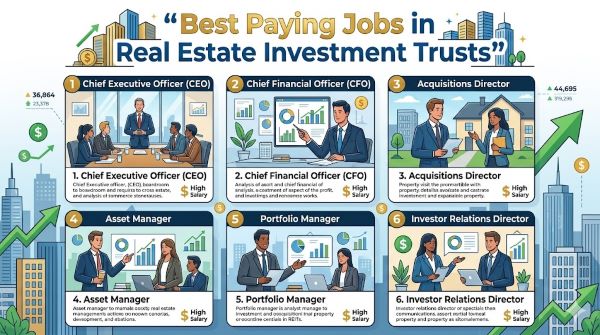
The best paying jobs in real estate investment trusts require experience and expertise.
Asset manager ($90,000-$150,000+):
- Oversee multiple properties
- Drive value creation
- Make capital allocation decisions
- Manage significant budgets
Senior property manager ($85,000-$130,000+):
- Lead property management teams
- Supervise multiple managers
- Handle complex tenant issues
- Achieve operational excellence
Acquisitions manager ($95,000-$160,000+):
- Lead acquisition efforts
- Evaluate investment opportunities
- Manage acquisition timelines
- Make investment recommendations
Development manager ($100,000-$180,000+):
- Oversee property development
- Manage construction budgets
- Handle contractor relationships
- Deliver projects on time and budget
Portfolio manager ($110,000-$200,000+):
- Manage entire property portfolios
- Drive strategic decisions
- Report to executives
- Achieve return targets
Vice president ($150,000-$300,000+):
- Lead departments
- Manage budgets
- Set strategy
- Report to C-suite
Chief financial officer ($200,000-$500,000+):
- Manage company finances
- Handle investor relations
- Make strategic financial decisions
- Report to board of directors
Chief executive officer ($300,000-$1,000,000+):
- Lead entire company
- Set overall strategy
- Manage board relationships
- Responsible for company performance
High-paying positions require significant experience, often 10-20+ years. But the compensation potential is substantial.
Specialized REIT Roles
Different REIT types create specialized positions.
Data center REITs employ:
- Infrastructure engineers
- Network specialists
- Power management experts
- Security specialists
These roles often pay premium salaries due to specialized knowledge.
Healthcare REITs employ:
- Healthcare compliance specialists
- Medical facility managers
- Healthcare consultants
Medical knowledge increases compensation.
Logistics REITs employ:
- Supply chain specialists
- Logistics coordinators
- Operations managers
Logistics expertise commands higher pay.
Specialization often leads to higher compensation. Specialized knowledge is valuable.
Finance and Analysis Roles
Finance positions within REITs often pay well.
Financial analyst ($55,000-$85,000):
- Build financial models
- Analyze investment returns
- Track financial performance
- Support investment decisions
Senior financial analyst ($80,000-$120,000):
- Lead analysis projects
- Create complex models
- Present to executives
- Influence decisions
Controller ($100,000-$160,000):
- Manage accounting department
- Ensure financial accuracy
- Handle regulatory compliance
- Report to CFO
Treasurer ($120,000-$200,000+):
- Manage company cash
- Handle financing
- Manage investor relations
- Report to CFO
Finance roles leverage strong analytical skills and attention to detail. They offer good compensation growth.
Required Skills and Education
Best paying jobs in real estate investment trusts typically require specific backgrounds.
Education:
Bachelor’s degree in real estate, finance, business, or related field is common minimum.
MBA or similar advanced degree opens senior doors. Many executives have MBAs.
Professional certifications like CPM (Certified Property Manager) add credibility.
Skills:
Financial analysis and modeling Real estate market knowledge Property operations understanding Relationship management Project management Strategic thinking Communication skills Leadership ability
Developing these skills increases earning potential and advancement speed.
Career Progression Timeline
A typical REIT career might look like:
Entry-level analyst: Year 1-3, $45,000-$65,000 Senior analyst: Year 3-5, $65,000-$95,000 Manager: Year 5-8, $85,000-$130,000 Senior manager: Year 8-12, $120,000-$200,000 Director: Year 12-15, $180,000-$300,000 VP/C-suite: Year 15+, $200,000-$1,000,000+
Career progression depends on performance, opportunities, and company growth. Some advance faster than this timeline. Others progress slower.
Benefits Beyond Salary
REIT positions often include significant benefits.
Benefits package:
Health insurance (medical, dental, vision) 401k matching Paid time off Life insurance Disability insurance Professional development budget Stock options Performance bonuses Deferred compensation plans
Total compensation often exceeds base salary by 20-40%. High-level positions might include significant equity stakes.
REIT Industry Outlook
The REIT industry shows generally positive long-term outlook.
Growth drivers:
Aging population needs senior housing Retail transformation creates logistics demand Data center growth from cloud computing Healthcare facilities needed nationwide Work-from-home driving office evolution
Challenges:
Rising interest rates affect financing costs Economic recessions reduce property values Retail disruption from e-commerce Construction cost inflation
Overall, REITs employ steady numbers with growth in certain sectors like logistics and data centers.
Getting Started in REIT Careers
If you’re interested in best paying jobs in real estate investment trusts, here’s how to start.
Step 1: Earn relevant degree Consider real estate, finance, or business degree. It opens doors and establishes knowledge.
Step 2: Gain entry-level experience Apply for analyst, coordinator, or assistant roles. Build foundational knowledge.
Step 3: Develop specialized skills Learn financial modeling, valuation, market analysis. These skills increase value.
Step 4: Network in industry Attend real estate conferences. Join professional organizations. Build relationships.
Step 5: Pursue growth opportunities Move to positions with more responsibility. Take on leadership roles.
Step 6: Consider advanced credentials MBA, CPM, or other credentials signal expertise and open senior doors.
Comparing to Other Industries
REIT salaries compare favorably to many industries.
Finance sector: Often pay similarly, but REIT work is less intense than investment banking.
Consulting: Management consulting pays more but demands longer hours.
Technology: Tech salaries often exceed REITs, but REIT jobs offer better work-life balance.
Accounting: REIT accounting roles pay more than general accounting.
REIT positions offer competitive compensation with reasonable work-life balance. That combination appeals to many professionals.
Key Takeaways
- Best paying jobs in real estate investment trusts range from $45,000 in entry-level roles to $1,000,000+ in C-suite positions.
- Is real estate investment trusts a good career path depends on your interests, but the industry offers stability, growth, and decent compensation.
- How many jobs are available in real estate investment trusts varies by economic cycle, with thousands of positions across the country.
- REIT real estate operations require diverse professionals in management, finance, development, and operations.
- Are REITs a good investment affects REIT industry health, employment stability, and career opportunities.
- Entry-level REIT positions pay $35,000-$65,000 and offer learning opportunities.
- Mid-level positions pay $55,000-$100,000 with increased responsibility and leadership.
- High-paying REIT positions exceed $100,000 and reach into the hundreds of thousands.
- Specialized REIT roles in data centers, healthcare, or logistics often pay premium salaries.
- Finance and analysis roles within REITs offer solid compensation growth.
- Career progression typically takes 15-20 years to reach executive levels.
- Benefits packages often add 20-40% to base salary value.
- The REIT industry shows positive long-term growth, especially in logistics and data centers.
- Building skills in financial analysis, property operations, and market knowledge increases earning potential.
- REIT careers offer competitive compensation with better work-life balance than some finance alternatives.
- If you’re interested in best paying jobs in real estate investment trusts, start with education, gain entry-level experience, develop specialized skills, and progress into management and leadership roles.