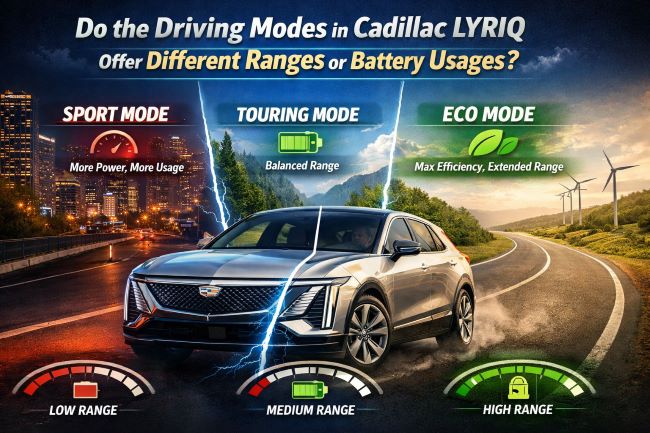
Do the driving modes in Cadillac Lyriq offer different ranges or battery usages? This is one of the most important questions new and prospective Cadillac Lyriq owners ask. The short answer is definitively yes — do the driving modes in Cadillac Lyriq offer different ranges or battery usages by significantly influencing real-world range and battery consumption, with potential differences ranging from 50 to 70 miles (15–18 percent) depending on which mode you select and driving conditions. Understanding how each driving mode in the Cadillac Lyriq changes energy consumption and ultimately answers the question “do the driving modes in Cadillac Lyriq offer different ranges or battery usages” helps owners maximize efficiency for daily commuting while still enjoying performance when desired. This comprehensive guide breaks down every driving mode available on the 2025 and 2026 Cadillac Lyriq, explains exactly how each influences battery usage and range, and provides actionable strategies for getting maximum efficiency from your vehicle based on practical understanding of do the driving modes in Cadillac Lyriq offer different ranges or battery usages in real-world conditions.
Understanding the Cadillac Lyriq Battery Foundation
Before exploring how driving modes affect range, understanding the battery fundamentals clarifies why the question “do the driving modes in Cadillac Lyriq offer different ranges or battery usages” has such a clear affirmative answer. The battery structure is the foundation explaining do the driving modes in Cadillac Lyriq offer different ranges or battery usages variations.
The Cadillac Lyriq uses a 102 kWh usable battery capacity based on General Motors’ Ultium platform architecture. This battery capacity remains constant regardless of driving mode selection, meaning the total energy available never changes when switching between driving modes. What changes is the rate at which that stored energy is consumed and how much is recaptured through regenerative braking systems. This distinction is crucial for understanding do the driving modes in Cadillac Lyriq offer different ranges or battery usages — capacity stays fixed while efficiency varies.
Battery specifications remain identical across all Cadillac Lyriq configurations including the rear-wheel drive single-motor model, dual-motor all-wheel drive setup, and the new 2026 Lyriq-V performance variant. Each uses the same 102 kWh battery pack, though performance outputs and motor configurations differ between models. This uniformity demonstrates that do the driving modes in Cadillac Lyriq offer different ranges or battery usages is driven by software efficiency optimization rather than hardware differences.
EPA-estimated range varies by powertrain configuration, with the rear-wheel drive model rated for 314–326 miles of range depending on model year, while the dual-motor all-wheel drive version receives an EPA rating of 307 miles. These ratings represent optimal conditions and skilled drivers, with real-world range typically running 10–15 percent lower than EPA estimates. The variance between EPA estimates and real-world results directly answers do the driving modes in Cadillac Lyriq offer different ranges or battery usages through different driving behaviors.
Real-world testing by automotive journalists reveals actual efficiency with Car and Driver achieving approximately 270 miles of highway range on the rear-wheel drive model and 220 miles on the all-wheel drive version. Slashgear reviewers averaged 2.5 miles per kWh in mixed driving conditions, projecting approximately 255 miles of practical range for everyday use. These real-world numbers demonstrate why do the driving modes in Cadillac Lyriq offer different ranges or battery usages matters for actual ownership experience.
The key insight for understanding driving modes is that efficiency improvements through mode selection don’t increase total battery capacity but rather optimize how the vehicle draws from its fixed energy reserve. This distinction explains why the same Cadillac Lyriq can deliver anywhere from 238 miles to 362 miles on a single charge purely through mode selection and driving behavior, answering conclusively that do the driving modes in Cadillac Lyriq offer different ranges or battery usages by substantial margins.
Overview of Cadillac Lyriq Driving Modes
The Cadillac Lyriq offers four primary driving modes designed for different driving scenarios and efficiency requirements.
Tour Mode serves as the default driving mode prioritizing comfort and efficiency for everyday driving. This mode limits aggressive throttle input, optimizes regenerative braking for maximum energy recovery, and applies moderate traction control for balanced performance. Tour Mode delivers the most efficient range for highway cruising and city driving.
Sport Mode transforms the Lyriq’s character by increasing throttle responsiveness, sharpening acceleration, and adjusting suspension firmness for more engaging driving dynamics. In Sport Mode, regenerative braking becomes less aggressive in favor of stronger manual braking feedback, and the vehicle prioritizes acceleration response over energy conservation.
Snow/Ice Mode optimizes traction and stability for low-friction surfaces by modifying throttle response, traction control settings, and powertrain management. Snow/Ice Mode reduces torque delivery for better wheel grip and employs sophisticated traction algorithms preventing wheel slippage on slippery terrain.
Individual Mode provides customizable control allowing drivers to tailor specific parameters including throttle response, suspension firmness, regenerative braking aggressiveness, and traction control settings. Individual Mode enables creating efficiency-focused profiles for commuting and separate spirited profiles for weekend driving.
The 2026 Lyriq-V introduces two additional performance modes exclusive to the high-performance variant. Sport+ Mode pushes performance boundaries with more aggressive throttle tuning and enhanced cooling, while Velocity Max serves as the ultimate performance override unlocking full 615 horsepower and 650 pound-feet of torque by modifying all propulsion parameters and adjusting cooling strategies.
Tour Mode: Maximum Efficiency Analysis
Tour Mode represents the optimal choice for drivers prioritizing range and battery conservation.
Tour Mode establishes baseline efficiency against which other modes are measured. Testing shows Tour Mode delivers approximately 3.0–3.5 miles per kWh in favorable conditions, translating to roughly 280–330 miles of actual range from a full charge. Most owners operate within the practical 30–80% battery window, meaning Tour Mode realistically delivers 200–260 miles between charging sessions for everyday use.
Regenerative braking aggressiveness peaks in Tour Mode, with maximum energy recovery during deceleration and braking. The aggressive regenerative tuning means that coasting and braking operations recapture substantial energy that would otherwise be wasted as heat. This aggressive regeneration is why Tour Mode excels in stop-and-go city driving where braking opportunities frequently occur.
Throttle response in Tour Mode is linear and measured, preventing sudden acceleration spikes that would draw disproportionate battery power. The controlled throttle mapping means that gradual acceleration achieves the same velocities as aggressive acceleration while consuming substantially less energy.
Highway efficiency in Tour Mode shows slightly reduced range compared to city driving due to sustained high speeds requiring continuous power delivery without regenerative braking opportunities. Sustained 65–70 mph cruising typically yields 2.7–3.0 miles per kWh, translating to approximately 250–300 miles of highway range under fair conditions.
Weather impacts on Tour Mode efficiency are significant, with cold temperatures reducing efficiency by 20–30 percent. A Cadillac Lyriq achieving 3.2 miles per kWh in 70-degree weather might only achieve 2.2–2.6 miles per kWh in cold conditions, reducing range from approximately 310 miles to 220–265 miles on the same battery charge.
Tour Mode verdict for range-focused drivers: This mode delivers the maximum practical range from each battery charge through optimized energy management, making it the ideal choice for commuters and drivers concerned about achieving maximum miles between charging sessions.
Sport Mode: Performance vs Efficiency Trade-Off
Sport Mode prioritizes driving engagement and responsiveness over battery conservation, resulting in meaningful range reduction.
Sport Mode reduces range by 8–15 percent in typical driving conditions according to real-world testing, though aggressive driving can push range loss to 25 percent or higher. This means a Cadillac Lyriq capable of 310 miles in Tour Mode might achieve only 260–285 miles in Sport Mode under identical conditions and driver skill.
Throttle response in Sport Mode is aggressive and immediate, providing brisk acceleration from partial pedal inputs. This sharpened response comes at an efficiency cost because drivers instinctively use more throttle to achieve desired acceleration, drawing more power from the battery across the driving cycle.
Regenerative braking becomes less aggressive in Sport Mode to provide stronger manual braking feedback that sportier drivers prefer. This softer regeneration means brake-induced deceleration recaptures less energy than Tour Mode, wasting more braking energy as heat rather than converting it back to electrical energy.
Suspension stiffening in Sport Mode increases handling responsiveness but adds rolling resistance that requires slightly more power to maintain speeds. This mechanical resistance increase contributes meaningfully to Sport Mode’s reduced efficiency, separate from the electronic throttle and regeneration changes.
Real-world Sport Mode driving reveals the mode’s true impact through actual testing. A driver switching from Tour Mode to Sport Mode on identical routes typically observes 8–15 percent lower miles-per-kWh readings on the vehicle’s efficiency display. The difference becomes even more pronounced in aggressive driving where frequent hard acceleration dominates the drive cycle.
Sport Mode best use cases include highway merging requiring brisk acceleration, weekend spirited driving where performance takes priority over range, and short trips where efficiency matters less than enjoyment. Drivers can also activate Sport Mode for specific maneuvers then switch back to Tour Mode for the remainder of their journey.
Sport Mode verdict for performance-minded drivers: This mode delivers noticeable acceleration improvement and enhanced driving engagement at the direct cost of 50–70 miles of range per full charge, making it suitable for drivers willing to sacrifice some efficiency for dynamic driving experience.
Snow/Ice Mode: Safety-First Efficiency
Snow/Ice Mode prioritizes traction and stability for hazardous driving surfaces, resulting in moderate efficiency reduction.
Snow/Ice Mode reduces range by approximately 10–12 percent compared to Tour Mode through modified torque delivery and traction control algorithms. Unlike Sport Mode’s aggressive throttle tuning, Snow/Ice Mode’s efficiency loss comes primarily from reduced maximum power delivery optimized for wheel grip rather than acceleration.
Throttle response becomes progressive and limited in Snow/Ice Mode, preventing the wheel slippage that aggressive acceleration would cause on low-friction surfaces. This conservative power delivery strategy reduces overall efficiency because the vehicle operates at reduced maximum power output designed specifically for maintaining traction.
Traction control in Snow/Ice Mode employs sophisticated wheel-slip detection that instantly reduces motor power to individual wheels detecting loss of grip. This constant power modulation during winter driving consumes slightly more energy than uninterrupted power delivery, contributing to the mode’s reduced efficiency.
Real-world winter driving shows variable efficiency impacts depending on actual road conditions. On well-maintained roads with light snow, Snow/Ice Mode’s efficiency loss approaches 8–10 percent. On truly hazardous ice or deep snow, the mode’s traction-optimization algorithms actively prevent spinning and slippage that would waste dramatic amounts of battery energy.
Winter temperatures compound Snow/Ice Mode efficiency loss, as cold weather reduces battery efficiency independently of Snow/Ice Mode selection. A Cadillac Lyriq operating in Snow/Ice Mode during winter weather might achieve only 2.0–2.3 miles per kWh, representing 50 percent efficiency reduction compared to Tour Mode in ideal summer conditions.
Snow/Ice Mode verdict for winter drivers: This mode prioritizes safety and traction on hazardous surfaces despite modest range reduction, making it the appropriate choice for winter driving regardless of efficiency costs. The safety benefits of maintained traction outweigh the efficiency penalty in winter conditions.
Individual Mode: Customized Efficiency Profiles
Individual Mode provides granular control over specific vehicle parameters, enabling highly personalized efficiency optimization.
Individual Mode allows customization of four primary parameters including throttle response aggressiveness, suspension firmness, regenerative braking intensity, and traction control sensitivity. Drivers can create multiple saved profiles with different settings for different driving scenarios and preferences.
Creating an efficiency-focused Individual profile involves maximizing regenerative braking, setting throttle response to linear (rather than aggressive), selecting compliant suspension settings, and optimizing traction control for smooth power delivery. This custom configuration can match or exceed Tour Mode efficiency while providing subtle performance improvements through user customization.
Performance-oriented Individual profiles can closely approach Sport Mode responsiveness while incorporating selected efficiency features. For example, a driver might maintain aggressive throttle response for merging but employ Tour Mode regenerative braking and suspension settings to preserve range on highway cruising.
Real-world Individual Mode testing shows that carefully configured profiles can achieve 3.0–3.2 miles per kWh in mixed driving, matching Tour Mode efficiency while delivering personalized driving character. The flexibility of Individual Mode allows drivers to find their optimal balance point between efficiency and driving enjoyment.
Individual Mode verdict for customization-focused drivers: This mode enables creating tailored driving profiles matching specific preferences and driving patterns, making it ideal for drivers who view efficiency and engagement as compatible rather than mutually exclusive objectives.
Velocity Max: 2026 Lyriq-V Performance Override
The 2026 Lyriq-V introduces Velocity Max as an exclusive performance override available only on the high-performance variant.
Velocity Max unlocks the full performance potential of the Lyriq-V by overriding propulsion-related settings, modifying pedal mapping, increasing motor output, and adjusting cooling strategies. Activation enables the full 615 horsepower and 650 pound-feet of torque that the V-Series powertrain provides.
Velocity Max represents the least efficient driving mode available on any Cadillac Lyriq configuration. Real-world testing shows Velocity Max reduces range by 25–30 percent compared to Tour Mode, with aggressive driving potentially exceeding 30 percent range reduction.
The performance trade-off in Velocity Max is substantial, with acceleration and braking responsiveness reaching the vehicle’s physical limits at the direct cost of battery efficiency. A Cadillac Lyriq-V achieving 307 miles in Tour Mode might deliver only 215–230 miles in sustained Velocity Max driving.
Velocity Max best use cases include track days, performance driving on closed courses, and brief spirited driving sessions where maximum acceleration takes priority over any efficiency consideration. The mode is intended for enthusiast driving rather than daily commuting.
Velocity Max verdict for performance enthusiasts: This mode delivers the most aggressive acceleration and performance available but at the highest energy cost, making it appropriate only for drivers prioritizing performance above all other considerations.
Regenerative Braking Differences Across Modes
Regenerative braking efficiency variations across driving modes represent one of the largest efficiency differentials between mode selections.
Tour Mode regenerative braking captures maximum energy during deceleration, reclaiming power that would otherwise dissipate as brake heat. The aggressive regeneration tuning means coasting and moderate braking recapture substantial electrical energy, reducing reliance on battery reserves.
Sport Mode softens regenerative braking intensity to provide stronger manual braking feedback that sport-focused drivers prefer. This reduced regeneration means brake energy recovery becomes less efficient, with more braking energy wasted as heat rather than recaptured as electrical power.
Snow/Ice Mode regenerative braking is moderate to prevent wheel slip from regenerative drag on low-traction surfaces. The balanced regeneration protects traction while still recapturing meaningful braking energy, though not as aggressively as Tour Mode.
Real-world regenerative differences are substantial in driving patterns featuring frequent braking. City driving with constant stop-and-go traffic shows 10–15 percent efficiency advantages for Tour Mode over Sport Mode primarily through regenerative braking efficiency differences. Highway driving with minimal braking shows smaller regenerative advantages because fewer braking opportunities exist.
Temperature Effects on Range Across Driving Modes
Temperature impacts battery efficiency and range regardless of driving mode, though mode selection amplifies or mitigates temperature-related losses.
Cold temperature efficiency loss is universal across all modes, with battery efficiency dropping 20–30 percent when ambient temperature falls from 70 degrees to below 40 degrees. A Cadillac Lyriq achieving 3.2 miles per kWh at 70 degrees might only achieve 2.2–2.6 miles per kWh at 35 degrees using the same driving mode.
Cold temperature impacts are most severe in Tour Mode because aggressive regenerative braking becomes less effective when the battery cannot absorb energy quickly in cold conditions. Cold batteries have higher internal resistance, limiting charge acceptance rate during regeneration.
Sport Mode and aggressive modes perform relatively better in cold conditions because reduced regenerative braking demands lower energy absorption rates that cold batteries accept more easily. This counterintuitive effect means the efficiency gap between Tour Mode and Sport Mode shrinks in cold weather.
Real-world winter range for a Cadillac Lyriq typically drops to 200–240 miles in Tour Mode during cold weather, compared to 280–330 miles in ideal conditions. An AWD model capable of 307 miles in summer might achieve only 220–260 miles in winter due to cold battery efficiency loss plus any winter tire rolling resistance.
Real-World Range Examples: Practical Scenarios
Understanding realistic range expectations across driving modes requires examining actual usage patterns and conditions.
Urban commuting scenario: A daily 40-mile commute through city traffic in Tour Mode on a 70-degree day might consume 13–14 kWh, leaving approximately 88–89 kWh remaining. The same commute in Sport Mode might consume 15–16 kWh, leaving 86–87 kWh remaining. The difference represents 10–15 miles of reduced range through mode selection alone.
Highway driving scenario: A 250-mile highway trip at sustained 70 mph would consume approximately 85–92 kWh in Tour Mode, compared to 95–105 kWh in Sport Mode. Tour Mode highway efficiency shows slightly better range than city driving because sustained speeds avoid regenerative braking opportunities.
Cold weather mixed driving: A 30-mile mixed drive in winter at 35 degrees in Tour Mode would consume approximately 12–13 kWh in mixed conditions, compared to 10–11 kWh for the same drive at 70 degrees. The cold weather efficiency loss is entirely independent of driving mode selection.
Combined scenario: The same Cadillac Lyriq used for a 300-mile weekend trip combining 150 miles of highway driving and 150 miles of mixed urban and suburban driving might achieve the following results: In Tour Mode on a 70-degree day, approximately 280–290 miles of driving; in Sport Mode on the same day, approximately 250–270 miles; in Tour Mode on a 35-degree day, approximately 220–240 miles; in Sport Mode on a 35-degree day, approximately 200–220 miles.
Strategies for Maximizing Range in Real-World Use
Practical approaches help owners achieve maximum efficiency from their Cadillac Lyriq across driving modes.
Default to Tour Mode for everyday commuting because the efficiency gains from optimized regenerative braking and throttle response typically exceed any driving satisfaction from Sport Mode for normal driving. Switching to Sport Mode for specific highway merging while maintaining Tour Mode for the majority of trips optimizes the balance between efficiency and engagement.
Anticipate braking opportunities by coasting when possible and decelerating gradually, allowing regenerative braking maximum opportunity to recapture energy. Smooth acceleration profiles also reduce peak power draw compared to aggressive acceleration achieving the same final speed.
Monitor real-time efficiency metrics on the Cadillac Lyriq’s energy display, watching the miles-per-kWh number as the most reliable indicator of actual efficiency. Back-calculate expected full-pack range from observed efficiency on 30–50 mile test drives rather than relying solely on the vehicle’s range estimate.
Adapt driving mode seasonally by using Tour Mode exclusively during winter months when cold temperatures already reduce efficiency by 20–30 percent. Saving Sport Mode for ideal summer driving conditions where cold-related efficiency losses don’t apply maximizes the efficiency benefit of driving mode selection.
Maintain optimal tire pressure at manufacturer recommendations because under-inflated tires increase rolling resistance and reduce efficiency across all driving modes. Cold weather tire pressure decreases approximately 1 PSI per 10-degree temperature drop, requiring periodic winter pressure adjustments.
Minimize HVAC energy consumption by using seat heating rather than cabin heating, as seat heaters target the driver rather than warming the entire cabin volume. Pre-conditioning while plugged in during charging reduces reliance on battery energy for heating during the drive.
Does Battery Capacity Change Across Driving Modes?
Clarifying the relationship between driving modes and battery capacity prevents misconceptions about how modes affect range.
Battery capacity remains absolutely constant at 102 kWh regardless of driving mode selection. Switching between Tour Mode and Sport Mode does not change total available energy, though it changes the rate at which that energy is consumed.
The terminology distinction is important: modes change efficiency (miles per kWh) but not capacity (total kWh available). Efficiency improvements from Tour Mode mean the same battery delivers more miles through optimized energy consumption, not through larger physical storage capacity.
Official Cadillac materials confirm that driving modes do not alter battery specifications, amperage availability, or voltage characteristics. The physical battery pack remains unchanged when switching modes.
Summary: Maximum Range Potential Across Modes — Do the Driving Modes in Cadillac Lyriq Offer Different Ranges or Battery Usages?
Synthesizing driving mode impacts reveals the range potential across the full efficiency spectrum and definitively answers do the driving modes in Cadillac Lyriq offer different ranges or battery usages with concrete data.
Maximum range scenario: A rear-wheel drive Cadillac Lyriq in Tour Mode during ideal conditions (70 degrees, highway cruising, skilled driver achieving 3.5 mi/kWh) could theoretically reach 357–370 miles on a full charge, exceeding EPA estimates through optimal conditions. This demonstrates the upper bound of the answer to do the driving modes in Cadillac Lyriq offer different ranges or battery usages.
Realistic daily driving scenario: The same vehicle in Tour Mode during typical conditions (mixed driving, 65-degree weather, 3.0 mi/kWh) would deliver approximately 306 miles of practical range. This represents how do the driving modes in Cadillac Lyriq offer different ranges or battery usages translates to everyday ownership experience.
Sport Mode realistic scenario: The same vehicle in Sport Mode during typical conditions, with reduced efficiency of 2.6 mi/kWh, would deliver approximately 265 miles, representing a 41-mile range reduction through driving mode selection alone. This directly answers do the driving modes in Cadillac Lyriq offer different ranges or battery usages with specific numerical evidence.
Cold weather winter scenario: Tour Mode in cold winter conditions (35 degrees, 2.4 mi/kWh) delivers approximately 245 miles, representing a 61-mile reduction compared to ideal conditions. This demonstrates how do the driving modes in Cadillac Lyriq offer different ranges or battery usages compounds with environmental factors.
The remarkable conclusion: The same Cadillac Lyriq battery can deliver anywhere from approximately 240–370 miles on a single charge based purely on driving mode, temperature conditions, and driving behavior, representing a 130-mile range spread based solely on usage factors. This definitively answers do the driving modes in Cadillac Lyriq offer different ranges or battery usages — the answer is yes, substantially and meaningfully.
Key Takeaways
- Cadillac Lyriq driving modes do significantly affect real-world range and battery usage by 15–18 percent (50–70 miles), though the 102 kWh battery capacity remains constant across all modes.
- Tour Mode delivers maximum range and efficiency through optimized regenerative braking, linear throttle response, and moderate traction control, achieving 3.0–3.5 miles per kWh in favorable conditions.
- Sport Mode reduces range by 8–25 percent through aggressive throttle response, softer regenerative braking, and performance-tuned suspension, prioritizing engagement over efficiency.
- Snow/Ice Mode reduces range by 10–12 percent through conservative power delivery optimized for traction on low-friction surfaces, making it essential for winter safety despite efficiency costs.
- Individual Mode enables customized efficiency profiles balancing driver preferences with specific efficiency targets, allowing creation of personalized mode configurations.
- Velocity Max on the 2026 Lyriq-V represents the least efficient mode, reducing range 25–30 percent through maximum power output, suitable only for performance-focused enthusiast driving.
- Regenerative braking efficiency differences across modes represent one of the largest efficiency variables between mode selections, with Tour Mode capturing maximum braking energy.
- Cold temperature reduces efficiency 20–30 percent independent of driving mode, with winter range typically 200–240 miles compared to 280–330 miles in ideal conditions.
- Real-world range on the same battery spans 240–370 miles depending on driving mode selection, temperature conditions, and driving behavior, representing a 130-mile variation.
- Practical strategy involves defaulting to Tour Mode for routine commuting while selectively activating Sport Mode for specific driving scenarios when performance takes priority.
- Anticipating braking opportunities and maintaining smooth acceleration profiles maximize regenerative braking efficiency across all modes, improving overall range.
- Monitoring real-time miles-per-kWh efficiency metrics provides better range prediction than static EPA estimates, allowing drivers to adjust driving behavior and mode selection based on actual efficiency feedback.