One of the most common questions new parents ask — and one that causes more anxiety than it probably should — is how to dress baby for sleep. Get it right and your baby stays comfortable, sleeps well, and stays safe. Get it wrong in either direction and you are dealing with either a cold, restless baby or, more seriously, overheating — which is a genuine risk factor for SIDS (Sudden Infant Death Syndrome).
The good news is that dressing baby for sleep does not have to be complicated. Once you understand a few basic principles around room temperature, layering, and TOG ratings, the right choice becomes straightforward for any season or situation.
The Most Important Rule: Room Temperature First
Before thinking about what your baby wears, check the room temperature. The safest sleep environment for a baby sits between 68 and 72 degrees Fahrenheit (20 to 22 degrees Celsius). This range is comfortable for most babies and gives you a consistent baseline to work from when choosing sleepwear.
Overheating is the bigger risk. Babies cannot regulate their body temperature the way adults do. A cold baby will usually cry and alert you. A baby that is too hot may not wake up — which is exactly why overheating is linked to SIDS risk. When in doubt, dress your baby on the lighter side and check their temperature after they have been down for twenty to thirty minutes.
The right way to check: feel your baby’s chest or the back of their neck. These areas give you an accurate read on core body temperature. Hands and feet naturally run cooler due to immature circulation and are not reliable indicators of whether your baby is too warm or too cold.
What Is a TOG Rating and Why Does It Matter?
TOG stands for Thermal Overall Grade — a standardized measure of how much warmth a fabric provides. It is the number you will see on sleep sacks and baby swaddles. Understanding TOG ratings takes most of the guesswork out of dressing baby for sleep.
TOG ratings for baby sleepwear typically range from 0.2 to 3.5. Here is how to think about them:
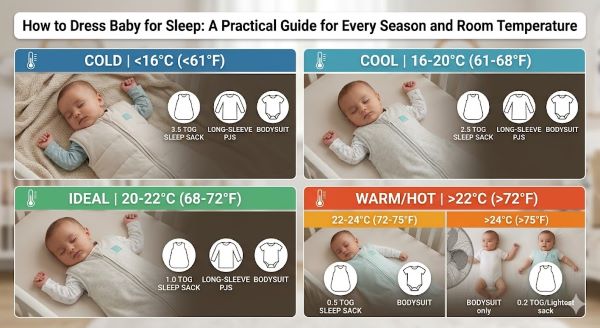
- 0.2 to 0.5 TOG: Very lightweight. Best for hot rooms above 75°F (24°C) or summer nights. Pair with a short-sleeve onesie or just a diaper.
- 1.0 TOG: Light coverage. Works well for rooms held consistently between 68–72°F (20–22°C). Pair with a long-sleeve bodysuit or lightweight footie pajamas.
- 2.5 TOG: Warmer coverage for cooler rooms between 61–68°F (16–20°C). Pair with a long-sleeve onesie and footie pajamas.
- 3.5 TOG: For cold rooms below 61°F (16°C). If your home reaches this point overnight, it is worth raising the room temperature rather than relying on heavy layering.
The key principle: match the TOG to the room temperature, not to the season. A well-heated home in winter may call for the same TOG as a moderate spring night. Base every decision on what the thermometer says, not what the weather is doing outside.
Baby Jumpers: The Everyday Sleep Layer
Baby jumpers — also called footed sleepers, onesie pajamas, or sleep suits — are the standard base layer for most babies at sleep time. They cover the body and feet in one piece, removing the risk of socks or pants coming off during the night and leaving the baby cold.
Baby jumpers come in different sleeve lengths and fabric weights, which is what you adjust based on room temperature:
Short-sleeve baby jumpers work for warmer rooms or as a base layer under a higher-TOG sleep sack in moderate conditions.
Long-sleeve baby jumpers are the standard choice for rooms held in the ideal 68–72°F range. They provide enough warmth on their own in mild conditions and combine well with a 1.0 or 1.5 TOG sleep sack in cooler rooms.
Fleece or heavier fabric baby jumpers should be used carefully. If your baby is already wearing a warm sleep sack, a heavy jumper underneath risks pushing the total warmth too high. Layering a light jumper with the right TOG sleep sack is more controllable than relying on one heavy piece.
Fabric matters too. Cotton and bamboo are the most breathable materials for baby jumpers used during sleep. They allow air circulation and reduce the risk of overheating. Synthetic fabrics trap more heat and are generally less suitable for sleep.
Sleep Sacks: The Safest Alternative to Blankets
Current safe sleep guidelines from the American Academy of Pediatrics (AAP) and equivalent bodies internationally recommend against loose blankets in a baby’s sleep space. Sleep sacks — also called wearable blankets — are the safe solution. They provide warmth without any loose fabric that could cover the baby’s face or restrict breathing.
A sleep sack goes on over your baby’s pajamas and stays in place through the night regardless of how much the baby moves. It eliminates the need for blankets entirely and removes any risk of the covering shifting during sleep.
Sleep sacks are available in the same TOG range as other baby sleepwear, so you can match the warmth to your room temperature the same way you would when choosing baby jumpers. Most families find having two or three sleep sacks in different TOG ratings covers every seasonal scenario without needing to buy a new one for every temperature shift.
Avoid weighted sleep sacks. Current guidelines specifically flag weighted infant sleep products as unsafe, as added weight can restrict chest expansion and breathing in young infants.
Should Babies Wear a Sleeping Hat?
This is a question many new parents have, particularly in cold weather or after reading older advice about keeping newborns’ heads covered.
For sleep at home, a sleeping hat is generally not recommended for most babies. The head is one of the main ways babies regulate and release body heat. Covering it with a hat during sleep increases the risk of overheating — which, as covered above, is the more serious risk to manage.
There are limited situations where a sleeping hat may be appropriate: very premature babies or low-birth-weight newborns, as directed by medical staff in a hospital setting, or in environments where room temperature genuinely cannot be maintained at a safe level. In these cases, guidance from a pediatrician or neonatal team should take precedence over general advice.
For healthy, full-term babies sleeping in a room held between 68–72°F, a sleeping hat adds unnecessary warmth and is not recommended as part of regular nighttime dressing.
A Season-by-Season Dressing Guide
Summer (Room above 75°F / 24°C)
- Diaper only, or a short-sleeve cotton onesie
- 0.2 to 0.5 TOG sleep sack if needed
- No sleeping hat
- Check chest temperature after 20 minutes — the baby should feel warm but not hot or sweaty
Spring and Fall (Room 68–72°F / 20–22°C)
- Long-sleeve baby jumper or footie pajamas
- 1.0 TOG sleep sack
- No sleeping hat
Winter (Room 65–68°F / 18–20°C)
- Long-sleeve baby jumper with footie pajamas
- 2.5 TOG sleep sack
- No sleeping hat
- Consider warming the room rather than adding extra layers if temperatures drop below 65°F
The same formula applies year-round: measure the room, match the TOG, adjust the base layer underneath. Do not add extra warmth because it is cold outside — what matters is the temperature where the baby is sleeping.
How to Tell If Your Baby Is Too Hot or Too Cold
Signs your baby is too hot:
- Chest or back of neck feels hot or sweaty
- Flushed or red cheeks
- Rapid breathing
- Unsettled, restless sleep
Signs your baby is too cold:
- Chest or back of neck feels cool to the touch
- Waking more frequently than usual
- Crying without another obvious cause
If your baby seems too warm, remove a layer or swap for a lower TOG sleep sack. If too cold, add a layer underneath the sleep sack rather than placing a blanket on top. The sleep sack keeps everything contained safely.
Quick Reference: Dressing Baby for Sleep
| Room Temperature | Base Layer | Sleep Sack TOG |
|---|---|---|
| Above 75°F (24°C) | Diaper or short-sleeve onesie | 0.2–0.5 |
| 72–75°F (22–24°C) | Short-sleeve onesie | 0.5–1.0 |
| 68–72°F (20–22°C) | Long-sleeve onesie or light footie pajamas | 1.0 |
| 65–68°F (18–20°C) | Footie pajamas | 1.5–2.5 |
| Below 65°F (18°C) | Long-sleeve onesie + footie pajamas | 2.5–3.5 |
Always check your baby’s chest or back of neck to confirm comfort. Adjust as needed.
Key Takeaways
- The starting point for dressing baby for sleep is always the room temperature, not the season. Keep the nursery between 68 and 72°F (20–22°C) for the safest sleep environment.
- Overheating is more dangerous than being slightly cool. When in doubt, dress lighter and check your baby’s chest or back of neck after 20–30 minutes.
- Never check temperature using hands or feet — they naturally run cooler than the baby’s core and give an inaccurate reading.
- TOG ratings measure how much warmth a sleep sack or swaddle provides. Match the TOG to room temperature: 0.5 TOG for warm rooms, 1.0 for ideal temperatures, 2.5 for cooler rooms.
- Baby jumpers in breathable cotton or bamboo are the standard base layer for sleep. Choose short or long sleeves based on room temperature and the TOG of the sleep sack going on top.
- Sleep sacks are the safest alternative to loose blankets and are recommended by the AAP. They keep the baby warm without any loose fabric that could shift during sleep.
- Avoid weighted sleep sacks — current safety guidelines flag these as unsafe for infants because the added weight can restrict breathing.
- A sleeping hat is not recommended for healthy, full-term babies sleeping at home. The head is a key heat-release point, and covering it during sleep increases overheating risk.
- If the room gets very cold overnight, warm the room rather than piling on extra clothing layers. Multiple heavy layers are harder to calibrate safely than a well-controlled room temperature.
- Dressing baby for sleep becomes intuitive quickly. Once you know the room temperature and the TOG system, the right combination for any situation takes seconds to work out.