You’re booking a Spirit Airlines flight and worried about baggage. Budget airlines are notorious for strict baggage policies. Spirit airlines personal item size restrictions are real, and getting them wrong costs money.
Spirit Airlines is one of the most restrictive airlines regarding baggage. Understanding their policies prevents expensive gate fees and travel frustration. Let’s break down exactly what you need to know.
Understanding Spirit’s Baggage Structure
Spirit Airlines has a unique baggage system compared to traditional carriers. Most airlines give you a free carry-on bag and personal item. Spirit charges for almost everything.
The spirit personal item size is the one thing Spirit allows for free on all tickets. Everything else costs money. This structure is why Spirit fares appear cheap until you add baggage fees.
The basic structure works like this:
- Personal item: Free with all tickets
- Carry-on bag: Costs money ($34-45 depending on booking method)
- First checked bag: Costs money ($35-40)
- Second checked bag: Costs money ($45-50)
Understanding this structure explains why many people use only a spirit personal item for short trips. It’s the only free baggage option.
Spirit Airlines Personal Item Size Specifications
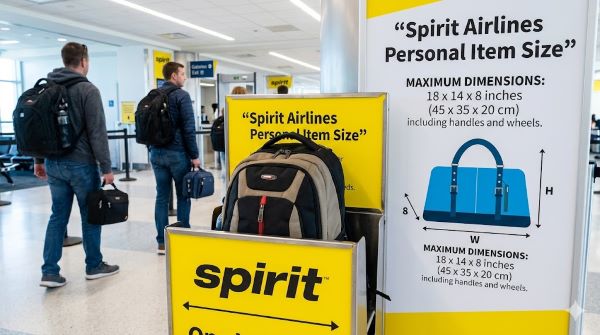
The official spirit airlines personal item size limit is 16 inches (length) x 14 inches (width) x 12 inches (height). This translates to 3,136 cubic inches of space.
This size is smaller than most airlines allow. Delta, United, and American allow personal items up to 22 x 14 x 9 inches. Spirit’s restriction is more compact.
The weight limit for personal items is 25 pounds. Most people never hit the weight limit. The size restriction is the real constraint.
Spirit measures bags at the gate. If your spirit personal item size exceeds the limit, they charge you $100 to gate-check the bag. This fee is significant compared to the original flight cost on budget fares.
What Qualifies as a Personal Item
A spirit personal item can be:
- A small backpack or daypack
- A purse or shoulder bag
- A laptop bag or briefcase
- A small rolling carry-on (if it fits dimensions)
- A small messenger bag
The item must fit completely under the seat in front of you. If any part protrudes, Spirit may reject it.
Common items that don’t work as personal items include full-size rolling luggage, large backpacks, and standard carry-on bags. These exceed the spirit personal item size limit.
Spirit Carry On Size vs Personal Item
Many people confuse spirit carry on size with personal item size. They’re different.
A spirit carry on bag size is 22 x 18 x 10 inches. This is larger than the personal item and costs money to bring on the plane. You pay $34-45 depending on whether you book it when purchasing the ticket or at the gate.
The difference in dimensions is significant. The carry-on is taller and wider than the personal item. If you need more space than a personal item provides, you pay for a carry-on.
Some people strategically use a personal item and avoid carry-on fees. Others buy the carry-on option to avoid gate fees. The choice depends on your needs and budget.
Spirit Carry On Fees and Timing
Buying a spirit carry on at the time of booking costs $34 if booked online, $45 at the airport counter or gate. This fee difference incentivizes early commitment.
If you wait to buy a carry-on at the gate, you pay the higher price. However, if your item doesn’t fit the personal item dimensions and you didn’t buy a carry-on, Spirit charges a $100 gate check fee. The math strongly favors buying in advance.
Many budget travelers avoid the carry-on fee by packing light. The personal item works for short trips. For week-long vacations, the carry-on fee becomes necessary.
Spirit Checked Bag Weight and Spirit Checked Bag Size Restrictions
Beyond personal and carry-on items, Spirit charges for checked bags.
The first spirit checked bag size limit is 62 inches (length + width + height). The spirit checked bag weight limit is 40 pounds for the first checked bag, 50 pounds for the second.
These limits are standard among airlines. Spirit charges $35-40 for the first checked bag. Additional bags cost more.
The weight limits are strict. If your bag exceeds 40 pounds, Spirit charges an additional $25 per 5-pound increment. A 45-pound bag costs an extra $25. A 50-pound bag costs an extra $50.
Knowing these limits prevents surprise charges at the airport. Weigh bags at home before arriving at the airport.
Measuring Your Bag
Before booking, measure any bags you plan to bring. The spirit personal item size restriction is specific and enforced.
Use a tape measure or ruler. Measure length, width, and height at the widest points. Add wheels or handles to the measurement if they extend beyond the main bag.
A backpack that fits other airlines might exceed Spirit’s personal item dimensions. Most traditional carry-on bags exceed the limit.
Soft-sided bags are slightly more forgiving since they compress. Hard-sided bags cannot compress and must fit precisely.
Packing Strategy for Spirit
Understanding these policies helps you pack strategically.
For a short trip using only a personal item:
- Use a small backpack (15x13x11 inches approximately)
- Pack only essentials
- Wear bulky items rather than packing them
- Use compression bags to maximize space
- Wear your heaviest shoes on the plane
- Minimize toiletries by using travel sizes
For a trip requiring more luggage:
- Buy a carry-on bag at booking ($34)
- Use the carry-on plus a personal item
- Skip checked bags if possible
- If you need checked luggage, budget the $35-40 fee
Common Items and Their Viability
Here’s what fits and what doesn’t in a spirit personal item:
What fits:
- Laptop bags and briefcases
- Small backpacks
- Purses and shoulder bags
- Small rolling bags with wheels
- Diaper bags (though tight)
- Camera bags
What doesn’t fit:
- Standard carry-on rolling luggage
- Large hiking backpacks
- Full duffel bags
- Medium or large roller bags
Testing items before traveling prevents gate surprises. If you’re uncertain, bring a small bag instead. The personal item space is genuinely limited.
Spirit’s Enforcement
Spirit strictly enforces spirit airlines personal item size limits. Gate agents measure items that appear close to the limit.
The enforcement is consistent across flights. You won’t get a warning or break. If your item exceeds dimensions, you pay $100 or check it for additional fees.
This strict enforcement is why Spirit fares are cheap. They make revenue from baggage fees. Without strict enforcement, everyone would ignore the policies.
Some travelers deliberately bring oversized items expecting negotiation. Gate agents don’t negotiate. The policy is firm.
Tips for Flying Spirit Successfully
Book in advance: Buy baggage options when booking flights, not at the gate. The prices are lower.
Measure carefully: Use an actual tape measure, not guesses. Eyeballing dimensions leads to problems.
Arrive early: Show up early at the airport. Gate agents are stricter as departure time approaches.
Keep personal items minimal: Use the absolute smallest bag that works. Marginal bags get questioned.
Know the fees: Understand that what costs nothing on other airlines costs money with Spirit. Budget accordingly.
Consider the total cost: A Spirit flight with baggage fees might cost more than a traditional airline with baggage included. Compare total prices, not just base fares.
Ask about policies: If uncertain, ask the flight attendant or gate agent before boarding or at the gate before paying fees.
Comparing to Other Airlines
Understanding how Spirit compares helps you make informed choices.
Most traditional airlines allow a free personal item and carry-on. Spirit charges for carry-on and everything beyond.
Southwest includes two free checked bags. Spirit charges for all checked bags.
Frontier Airlines has policies similar to Spirit. Both are ultra-low-cost carriers with strict baggage rules.
Budget airlines save money through these fees. If you pack light, you save money. If you pack normally, you pay more than traditional airlines.
Spirit Carry On Bag Size Real Examples
To illustrate the difference, here are real examples:
A standard rolling carry-on is typically 22 x 14 x 9 inches. This exceeds the spirit personal item size limit (16 x 14 x 12 inches) and requires a carry-on fee.
A small backpack of 18 x 13 x 8 inches fits comfortably as a personal item.
A laptop bag of 17 x 12 x 8 inches is borderline. It might fit but is close to the limit.
A purse or shoulder bag under 16 inches in any dimension is safe.
When in doubt, go smaller. Gate fees are expensive enough to make a smaller bag worthwhile.
Key Takeaways
- Spirit airlines personal item size is 16 x 14 x 12 inches, smaller than most airlines allow.
- The spirit personal item size is the only free baggage option with Spirit Airlines.
- Spirit personal item must fit completely under the seat in front of you with no protrusion.
- Spirit airline personal item size is strictly enforced with a $100 gate-check fee for oversized items.
- Spirit carry on size (22 x 18 x 10 inches) is separate from personal item and costs $34-45 to bring aboard.
- Spirit carry on fees are cheaper when purchased at booking ($34) versus at the gate ($45).
- Spirit carry on bag size is larger than personal item but smaller than traditional airline carry-ons.
- Spirit checked bag weight limits are 40 pounds for the first bag with $25 extra per 5-pound increment above that.
- Spirit checked bag size limit is 62 inches (length + width + height).
- Spirit personal item examples include small backpacks, laptop bags, and shoulder bags under the size limit.
- Understanding Spirit’s baggage structure prevents expensive gate fees and travel frustration.
- Always measure bags before traveling. The personal item limit is specific and consistently enforced.
- Budget travelers can save money using only a personal item for short trips.
- For longer trips, buying a carry-on at booking costs less than unexpected gate fees.
- Spirit Airlines baggage fees add up quickly, so factor them into total trip cost when comparing airlines.
- If you’re flying Spirit, measure your spirit airlines personal item size carefully and pack accordingly to avoid expensive surprises.