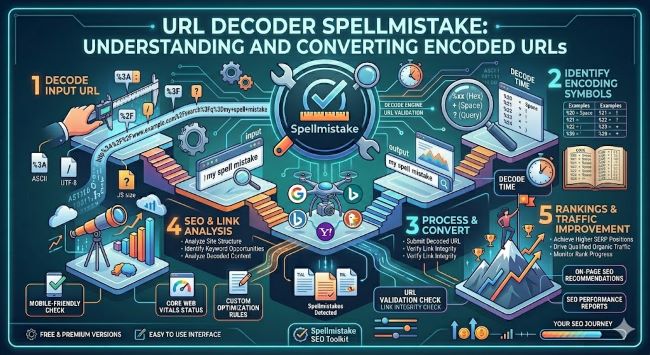
The phrase “url decoder spellmistake” represents tools combining URL decoding functionality with spell-check and error detection capabilities. URL decoder spellmistake tools help developers, marketers, and content creators decode encoded URLs while simultaneously identifying spelling or formatting errors. Understanding url decoder spellmistake functionality, appropriate applications, and limitations helps leverage these tools for debugging, analysis, and content validation. This comprehensive guide covers url decoder spellmistake tools, how they work, legitimate use cases, security considerations, and best practices for combining URL decoding with quality checking.
Understanding URL Decoder Spellmistake Tools
URL decoder spellmistake represents a specialized tool category.
URL decoding is the core functionality, converting URL-encoded characters (like %20 for spaces) into readable text. URL decoder spellmistake tools automate this conversion for any encoded URL or parameter string.
Spell-check integration adds error detection capabilities, identifying misspellings or formatting issues in decoded URLs or their parameters. URL decoder spellmistake provides dual functionality in single interface.
The keyword appears frequently when developers and analysts search for tools handling both URL decoding and content quality checking simultaneously, representing practical combined needs.
Services like SpellMistake integrate url decoder spellmistake capabilities as part of broader developer and content optimization tool suites.
Developer-focused design means url decoder spellmistake tools cater to technical users needing both decoding precision and error detection for quality assurance.
Free online availability characterizes most url decoder spellmistake tools, requiring no installation or account creation for basic functionality.
What URL Encoding and Decoding Mean
Understanding basics clarifies url decoder spellmistake purpose.
URL encoding converts special characters into percent-encoded format safe for transmission in URLs. Spaces become %20, ampersands become %26, and other special characters receive similar treatment.
URL decoding reverses this process, converting percent-encoded characters back to readable text. URL decoder spellmistake tools automate this conversion.
Reserved characters in URLs (like ?, &, =, #) have special meaning and require encoding when used in parameter values. URL decoder spellmistake reveals whether encoding was properly applied.
Character sets including Unicode and UTF-8 affect encoding complexity. URL decoder spellmistake tools handle various character encodings appropriately.
Query parameters commonly require decoding when analyzing URLs with multiple encoded values. URL decoder spellmistake makes parameter extraction straightforward.
Path components sometimes contain encoded characters requiring url decoder spellmistake analysis to understand file or resource names.
What URL Decoder Spellmistake Tools Actually Do
Understanding capabilities guides appropriate use.
URL decoding conversion transforms percent-encoded URLs into readable format, revealing hidden parameter values and path information that url decoder spellmistake displays clearly.
Batch decoding in advanced url decoder spellmistake allows processing multiple URLs simultaneously, useful for analyzing large datasets or crawl results.
Encoding validation checks whether URLs are properly encoded, identifying format errors that url decoder spellmistake flags for correction.
Parameter extraction in url decoder spellmistake identifies and lists individual URL parameters separately, simplifying analysis of complex URLs with multiple encoded values.
Spell-check integration detects misspellings or formatting inconsistencies in decoded content, adding quality assurance to url decoder spellmistake functionality.
Character encoding detection in url decoder spellmistake identifies what encoding scheme was used, handling UTF-8, Unicode, and ASCII appropriately.
Reversed encoding capability in some url decoder spellmistake tools allows re-encoding text to URL-safe format, supporting both directions of conversion.
Copy-paste convenience means url decoder spellmistake outputs are easily exportable for use in debugging, documentation, or analysis workflows.
How URL Decoder Spellmistake Tools Work
Using these tools effectively requires understanding the process.
Paste encoded URL into url decoder spellmistake input field — most tools accept URLs pasted directly from browsers or log files.
Automatic detection in url decoder spellmistake recognizes encoding format, handling various URL encoding standards appropriately.
Click decode button or url decoder spellmistake automatically processes input, completing conversion within seconds.
Review decoded output showing url decoder spellmistake results in readable format, revealing hidden parameters and values.
Check spell-check findings from url decoder spellmistake identifying potential errors in decoded content.
Copy results for use in other applications, with url decoder spellmistake supporting clipboard copying of decoded text.
Batch processing in advanced url decoder spellmistake tools allows pasting multiple URLs for simultaneous decoding and error detection.
Common URL Decoder Spellmistake Use Cases
Legitimate applications demonstrate tool value.
Debugging redirects where url decoder spellmistake reveals actual redirect parameters encoded in URLs, helping identify redirect issues quickly.
Email tracking analysis involves url decoder spellmistake decoding marketing tracking parameters in email click URLs, revealing how campaigns track user behavior.
API parameter inspection uses url decoder spellmistake to understand encoded parameters in API calls, aiding development and troubleshooting.
Link analysis for SEO auditing employs url decoder spellmistake to examine parameters and campaign tracking codes within links.
Suspicious URL inspection applies url decoder spellmistake to identify hidden content in shortened URLs, helping detect phishing or malware attempts.
UTM parameter decoding uses url decoder spellmistake to examine Google Analytics tracking parameters, understanding campaign attribution.
Form submission debugging uses url decoder spellmistake to inspect encoded form data in request URLs, identifying submission format issues.
Character encoding troubleshooting applies url decoder spellmistake when non-ASCII characters create issues, revealing encoding problems.
Security Considerations with URL Decoder Spellmistake
Understanding security implications requires caution.
Suspicious URL inspection with url decoder spellmistake can reveal malicious intent, but never click suspicious URLs directly — use url decoder spellmistake in safe, isolated environments only.
Phishing detection sometimes involves url decoder spellmistake analyzing hidden parameters in suspicious links, but verification remains essential.
Malware avoidance means never executing decoded URLs from unknown sources, only analyzing them with url decoder spellmistake in sandbox environments.
Credential protection requires ensuring url decoder spellmistake sessions don’t retain decoded URLs containing sensitive information like API keys or passwords.
Transmission security means avoiding pasting sensitive URLs into untrusted url decoder spellmistake tools online — use offline tools or trusted sources instead.
Data privacy concerns suggest avoiding uploading URLs containing personal information to third-party url decoder spellmistake services.
Browser security remains important even when using url decoder spellmistake, with careful verification before interacting with decoded URLs.
URL Decoder Spellmistake for Different Audiences
Tools serve diverse user types differently.
Developers use url decoder spellmistake for API debugging, understanding request parameters, and troubleshooting encoding issues in development workflows.
Digital marketers apply url decoder spellmistake to analyze campaign tracking URLs, understanding UTM parameters and attribution mechanisms.
SEO professionals leverage url decoder spellmistake for link audits, examining URL structure and parameters affecting search visibility.
Security researchers use url decoder spellmistake to analyze suspicious URLs safely, identifying embedded malicious content or phishing attempts.
QA testers employ url decoder spellmistake to verify URL generation in applications, ensuring parameters encode correctly.
System administrators apply url decoder spellmistake when analyzing server logs containing encoded URLs, extracting meaningful information.
Content creators use url decoder spellmistake’s spell-check features to validate URLs included in content, identifying broken or incorrectly formatted links.
Quality Concerns with URL Decoder Spellmistake
Understanding limitations prevents misuse.
Character encoding edge cases sometimes confuse url decoder spellmistake tools, particularly with non-ASCII characters or unusual encoding schemes.
Double encoding can cause issues where url decoder spellmistake decodes one layer but not fully, requiring manual re-processing.
Plus sign handling differs across url decoder spellmistake tools — some treat + as space (form encoding), others as literal +, creating confusion.
Incomplete decoding sometimes occurs when url decoder spellmistake fails to decode all layers, particularly with multiple encoding passes.
Spell-check false positives from url decoder spellmistake may flag technical terms, abbreviations, or proper nouns as misspellings inappropriately.
Context misunderstanding means url decoder spellmistake spell-check sometimes suggests corrections inappropriate for URLs or technical parameters.
Data loss risk in online url decoder spellmistake tools means sensitive information might be retained or logged by service providers.
Best Practices for URL Decoder Spellmistake Use
Leveraging tools responsibly requires strategic approach.
Use trusted sources only when url decoder spellmistake involves sensitive URLs, preferring established platforms or offline tools.
Never decode suspicious URLs directly — use url decoder spellmistake only to analyze URLs in safe, isolated environments, never to execute them.
Verify decoded information from url decoder spellmistake before trusting results, particularly when security decisions depend on accuracy.
Combine with link checkers using url decoder spellmistake alongside tools verifying URL validity and destination legitimacy.
Sanitize URLs before using url decoder spellmistake if they contain sensitive information like API keys, removing credentials first.
Document findings from url decoder spellmistake analysis, maintaining records of decoded parameters and identified issues.
Review spell-check suggestions carefully from url decoder spellmistake, accepting only corrections appropriate for URL context.
Batch processing safely when using url decoder spellmistake for multiple URLs, ensuring no sensitive data leakage in results.
Choosing Quality URL Decoder Spellmistake Tools
Evaluating options ensures reliability.
Accuracy testing involves running url decoder spellmistake on known URLs and verifying decoded output correctness before regular use.
Character encoding support matters for url decoder spellmistake tools handling international domains and special characters appropriately.
Batch processing capabilities valuable for url decoder spellmistake use in professional analysis of large URL datasets.
Privacy policies are critical for url decoder spellmistake tools, particularly regarding whether URLs are logged or retained.
No account requirements preferred for url decoder spellmistake tools to avoid unnecessary data collection or tracking.
Offline availability ideal for url decoder spellmistake when handling sensitive URLs, allowing local processing without transmission.
User interface clarity helps url decoder spellmistake usability, with intuitive design reducing interpretation errors.
Regular updates in url decoder spellmistake tools ensure character encoding standards compliance and security patches.
Comparing Manual vs Automated URL Decoding
Understanding when url decoder spellmistake helps most.
Simple URLs sometimes require only manual decoding, though url decoder spellmistake provides consistency and speed.
Complex URLs with multiple encoded parameters clearly benefit from url decoder spellmistake automation, reducing manual error risk.
Batch processing heavily favors url decoder spellmistake tools, making large-scale analysis practical.
Learning purposes might argue for manual decoding initially to understand processes before using url decoder spellmistake regularly.
Speed and efficiency benefit substantially from url decoder spellmistake, particularly for frequent URL analysis.
Accuracy requirements favor url decoder spellmistake when decode precision is critical for decision-making.
Documentation needs simplify with url decoder spellmistake providing reproducible, verifiable results.
Key Takeaways
- URL decoder spellmistake tools combine URL decoding (converting percent-encoded characters) with spell-check functionality, serving users needing both capabilities in unified platform.
- URL encoding converts special characters into percent-encoded format safe for URLs, while url decoder spellmistake reverses this process, revealing hidden parameters and values.
- Legitimate url decoder spellmistake applications include debugging redirects, analyzing email tracking, inspecting API parameters, SEO link analysis, and suspicious URL inspection.
- Security considerations require never decoding suspicious URLs directly, using url decoder spellmistake only in safe, isolated environments for analysis purposes.
- Developers, marketers, SEO professionals, security researchers, and QA testers each leverage url decoder spellmistake differently based on their specific needs and workflows.
- Batch processing capabilities in advanced url decoder spellmistake tools enable analyzing multiple URLs simultaneously, supporting professional large-scale analysis.
- Spell-check integration in url decoder spellmistake adds quality assurance, though false positives sometimes occur with technical terms and URL-specific formatting.
- Character encoding support matters for url decoder spellmistake tools handling international domains and non-ASCII characters appropriately across different encoding schemes.
- Privacy policies are critical when selecting url decoder spellmistake tools, particularly ensuring URLs containing sensitive data aren’t logged or retained by service providers.
- Best practices involve using trusted sources only, never executing decoded suspicious URLs, verifying decoded information, and sanitizing URLs before analysis.
- Quality url decoder spellmistake tools should support multiple character encodings, provide batch capabilities, maintain clear privacy policies, and require no account setup.
- Manual decoding rarely outperforms url decoder spellmistake except for learning purposes, with automation providing superior speed, accuracy, and consistency for practical applications.