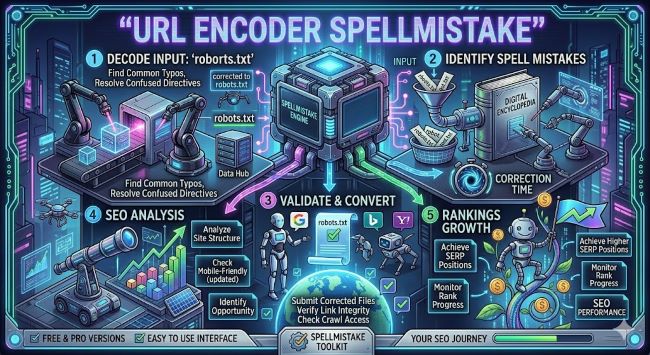
The phrase “url encoder spellmistake” represents tools combining URL encoding functionality with spell-check and validation capabilities. URL encoder spellmistake tools help developers, marketers, and content creators convert text and parameters into URL-safe format while detecting encoding errors or problematic characters. Understanding url encoder spellmistake functionality, proper applications, and limitations ensures safe URL creation and parameter handling. This comprehensive guide covers url encoder spellmistake tools, how they work, appropriate use cases, common errors, security considerations, and best practices for combining URL encoding with quality validation.
Understanding URL Encoding and Why It Matters
Comprehending encoding fundamentals clarifies url encoder spellmistake purpose.
URL encoding converts special characters into percent-encoded format safe for transmission in URLs. Spaces become %20, ampersands become %26, and reserved characters receive similar treatment to prevent parsing conflicts.
Special characters like spaces, punctuation, and non-ASCII characters require encoding in URLs to avoid ambiguity or corruption. URL encoder spellmistake handles this conversion automatically.
Reserved characters in URLs (?, &, =, #, /, 🙂 have special meaning and must be encoded when used in parameter values. URL encoder spellmistake ensures proper encoding context.
Parameter safety depends on proper encoding when building URLs with dynamic parameters. URL encoder spellmistake validates encoding appropriateness.
International characters and Unicode require proper encoding for URLs to work across systems. URL encoder spellmistake handles character set complexity.
Querystring parameters specifically need encoding when containing special characters or spaces. URL encoder spellmistake specializes in parameter encoding.
Email and form data encoding uses similar percent-encoding principles that url encoder spellmistake applies.
SEO implications of URL encoding affect how search engines interpret and index URLs created through url encoder spellmistake.
What URL Encoder Spellmistake Tools Actually Do
Understanding capabilities guides appropriate use.
URL encoding conversion transforms text and special characters into percent-encoded format that url encoder spellmistake displays in standard %XX notation.
Character validation checks whether characters require encoding, with url encoder spellmistake flagging problematic characters that might cause issues.
Batch encoding in advanced url encoder spellmistake allows processing multiple text strings simultaneously, useful for encoding large parameter lists.
Format preservation ensures url encoder spellmistake maintains URL structure while encoding parameters, keeping slashes and dots in appropriate places.
Character set detection in url encoder spellmistake identifies text encoding (UTF-8, Unicode, ASCII) and handles conversion appropriately.
Reverse decoding capability in some url encoder spellmistake tools allows encoding and decoding in both directions for testing.
Spell-check integration detects misspellings or problematic character combinations in text before encoding with url encoder spellmistake.
Format suggestions from url encoder spellmistake recommend encoding intensity and format options like application/x-www-form-urlencoded or multipart/form-data.
How URL Encoder Spellmistake Tools Work
Using these tools effectively requires understanding the process.
Input text or parameters into url encoder spellmistake — paste raw text or parameters to be encoded.
Select encoding format in url encoder spellmistake from available options like standard percent-encoding, form-URL-encoded, or other specifications.
Click encode button or url encoder spellmistake automatically processes input, completing encoding within seconds.
Review encoded output showing url encoder spellmistake results in percent-encoded format suitable for URL use.
Check validation results from url encoder spellmistake identifying potential issues with character choices or encoding compatibility.
Copy encoded result from url encoder spellmistake for use in URLs, parameters, or API calls.
Batch processing in advanced url encoder spellmistake tools allows encoding multiple values simultaneously with results clearly associated.
Common URL Encoding Errors
Understanding mistakes clarifies what url encoder spellmistake should prevent.
Double encoding occurs when text gets encoded multiple times, creating invalid URLs that url encoder spellmistake should prevent through clarity about processing stages.
Missing encoding of special characters creates ambiguous URLs that url encoder spellmistake catches by validating character safety.
Incorrect character sets result from encoding UTF-8 text as ASCII, which url encoder spellmistake prevents through proper character detection.
Plus sign confusion where + should be space in some contexts but literal + in others, a nuance url encoder spellmistake tools clarify.
Reserved character mishandling occurs when url encoder spellmistake encodes characters that shouldn’t be encoded in certain contexts.
Parameter separator issues where & or = characters need special handling that url encoder spellmistake must respect.
Space encoding variations between %20 and + representations that url encoder spellmistake clarifies by context.
Whitespace preservation errors where url encoder spellmistake accidentally encodes intentional whitespace incorrectly.
Appropriate Use Cases for URL Encoder Spellmistake
Legitimate applications demonstrate tool value.
Dynamic URL construction uses url encoder spellmistake when building URLs with parameter values containing special characters or spaces.
Email campaign links employ url encoder spellmistake to safely encode tracking parameters in click URLs.
API parameter encoding applies url encoder spellmistake when constructing API calls with complex parameter values.
Form data encoding uses url encoder spellmistake for encoding form submissions with special characters or international text.
Redirect parameter encoding applies url encoder spellmistake when creating redirect URLs with encoded destination parameters.
Search functionality uses url encoder spellmistake to encode user search queries in URLs for proper transmission.
International domain encoding applies url encoder spellmistake to Punycode-encode non-ASCII domain names for proper URL construction.
Testing and debugging employs url encoder spellmistake to verify proper encoding of problem URLs causing issues.
Security Considerations with URL Encoder Spellmistake
Understanding implications requires thoughtful approach.
Never encode sensitive data in URLs where url encoder spellmistake creates human-readable percent-encoding revealing information encoded.
Passwords and API keys should never be encoded in URLs — url encoder spellmistake encoding doesn’t provide security, only format conversion.
Personal information shouldn’t appear in URLs even when encoded through url encoder spellmistake, as encoding isn’t encryption.
HTTPS requirement means url encoder spellmistake use should only occur within HTTPS connections preventing URL interception.
Query string exposure in logs and browser history means url encoder spellmistake encoded parameters are still visible in plaintext logs and history.
SQL injection prevention sometimes involves proper url encoder spellmistake encoding, though parameterized queries are superior solutions.
XSS prevention benefits from proper url encoder spellmistake encoding of user input, though context-specific encoding is more important.
URL Encoder Spellmistake for Different Audiences
Tools serve diverse user needs differently.
Developers use url encoder spellmistake for API parameter encoding, form submission handling, and dynamic URL construction in applications.
Digital marketers apply url encoder spellmistake to email campaign links, UTM parameters, and tracking pixel URLs.
SEO professionals employ url encoder spellmistake to understand URL structure and verify proper parameter encoding affecting visibility.
QA testers use url encoder spellmistake to verify application URL generation, testing parameter encoding in various scenarios.
Content creators apply url encoder spellmistake when including encoded URLs in documentation or tutorials requiring proper formatting.
System administrators use url encoder spellmistake when analyzing server logs containing encoded URLs.
Security researchers employ url encoder spellmistake to analyze and understand encoded URLs in security testing.
Quality Concerns with URL Encoder Spellmistake
Understanding limitations prevents misuse.
Character encoding edge cases sometimes confuse url encoder spellmistake tools, particularly with uncommon character sets or combining characters.
Context-specific encoding requirements mean url encoder spellmistake might encode correctly for one use but incorrectly for another context.
Reserved character handling varies across systems, with url encoder spellmistake requiring awareness of context-specific rules.
International domain encoding complexity sometimes exceeds url encoder spellmistake capabilities without additional Punycode handling.
Legacy encoding support might be incomplete in url encoder spellmistake, particularly for older character sets or standards.
Format variant confusion where different encoding formats serve different purposes that url encoder spellmistake tools must clarify.
Spell-check false positives in url encoder spellmistake might flag technical terms, abbreviations, or proper nouns inappropriately.
Best Practices for URL Encoder Spellmistake Use
Leveraging tools responsibly requires strategic approach.
Encode only necessary values with url encoder spellmistake, avoiding redundant encoding of already-safe text.
Understand encoding context before using url encoder spellmistake, knowing whether application/x-www-form-urlencoded or standard percent-encoding applies.
Test encoded URLs after generation through url encoder spellmistake to verify functionality in target applications.
Never encode sensitive data in URLs even through url encoder spellmistake, using POST methods or secure transmission instead.
Document encoding decisions when url encoder spellmistake generates non-standard encoding for maintainability.
Use consistent tools across projects when url encoder spellmistake standardizes encoding behavior within teams.
Verify encoding compatibility with target systems before relying on url encoder spellmistake output.
Combine with security best practices rather than relying on url encoder spellmistake encoding alone for security.
Comparing Manual vs Automated URL Encoding
Understanding when url encoder spellmistake helps most.
Simple parameters with only alphanumeric text sometimes don’t require url encoder spellmistake automation.
Special characters clearly benefit from url encoder spellmistake automation, reducing manual encoding errors.
Complex parameters with multiple special characters and internationalization heavily favor url encoder spellmistake.
Batch processing clearly favors url encoder spellmistake tools, making large-scale encoding practical.
Learning purposes might argue for manual encoding initially before using url encoder spellmistake regularly.
Speed and efficiency substantially benefit from url encoder spellmistake, particularly for frequent encoding tasks.
Accuracy requirements favor url encoder spellmistake when encoding precision is critical for functionality.
Documentation needs simplify with url encoder spellmistake providing reproducible, verifiable results.
Choosing Quality URL Encoder Spellmistake Tools
Evaluating options ensures reliability.
Accuracy testing involves running url encoder spellmistake on known strings and verifying encoded output correctness before regular use.
Character set support matters for url encoder spellmistake handling international text and various character encodings appropriately.
Format options availability in url encoder spellmistake tools ensures flexibility for different encoding requirements.
User interface clarity helps url encoder spellmistake usability, with intuitive design reducing interpretation errors.
No account requirements preferred for url encoder spellmistake tools to avoid unnecessary data collection or tracking.
Batch capabilities valuable for url encoder spellmistake professional use with large parameter quantities.
Privacy policies ensure url encoder spellmistake doesn’t log or retain sensitive parameters.
Offline availability ideal for url encoder spellmistake when handling sensitive URLs without transmission risk.
URL Encoding Standards and Specifications
Understanding variations clarifies url encoder spellmistake differences.
Percent-encoding (RFC 3986) is the standard url encoder spellmistake uses, converting characters to %HH format.
Application/x-www-form-urlencoded format in url encoder spellmistake uses + for spaces and & as parameter separators.
Multipart/form-data encoding in url encoder spellmistake handles file uploads and complex form submissions.
UTF-8 encoding is the modern standard that url encoder spellmistake tools should default to for international support.
Punycode encoding in url encoder spellmistake converts internationalized domain names to ASCII-compatible format.
JavaScript encoding variants sometimes differ from standard url encoder spellmistake percent-encoding for specific language requirements.
Key Takeaways
- URL encoder spellmistake tools combine URL encoding (converting special characters to percent-encoded format) with validation and spell-check functionality in unified platforms.
- URL encoding converts special characters like spaces into percent-encoded format (%20) safe for URL transmission, functionality that url encoder spellmistake automates.
- Legitimate url encoder spellmistake applications include dynamic URL construction, email campaign links, API parameter encoding, form data encoding, and search parameter encoding.
- Common URL encoding errors including double encoding, missing encoding, incorrect character sets, and reserved character mishandling are prevented by url encoder spellmistake validation.
- URL encoder spellmistake should never be used for security purposes — encoding is format conversion only and provides no protection for sensitive data.
- Character set support in url encoder spellmistake matters for international text handling, particularly for UTF-8 and Unicode proper conversion.
- Batch processing capabilities in advanced url encoder spellmistake tools enable efficient encoding of large parameter lists simultaneously.
- Context-specific encoding requirements mean url encoder spellmistake tools must clarify whether application/x-www-form-urlencoded, standard percent-encoding, or other formats apply.
- Best practices involve encoding only necessary values, understanding encoding context, testing encoded URLs, and never encoding sensitive data in URLs.
- Spell-check integration in url encoder spellmistake tools adds quality assurance but may produce false positives with technical terms or proper nouns.
- HTTPS encryption remains essential for sensitive parameters even with url encoder spellmistake encoding, since encoding provides format conversion only.
- Quality url encoder spellmistake tools should support multiple character sets, offer various encoding formats, maintain privacy policies, and provide offline availability options.