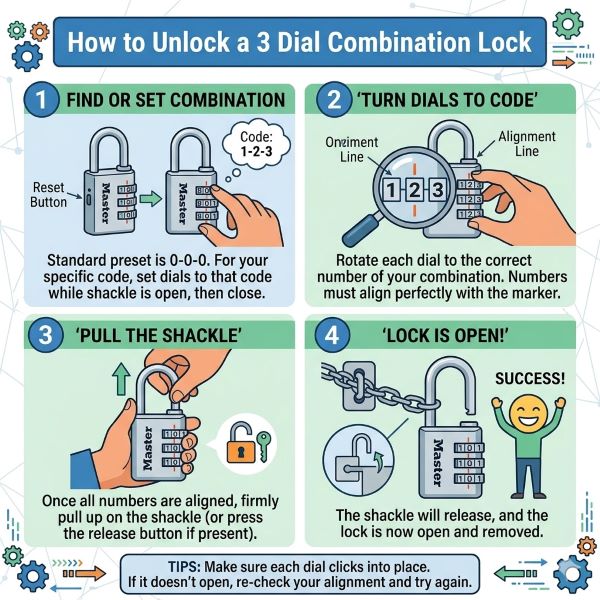
You stand in front of a locker with a combination lock. You spin the dials, but the lock won’t open. You forgot the combination. You need to know how to unlock a 3 dial combination lock quickly.
Understanding how to unlock a combination lock helps when you forget the combination, inherit a lock with an unknown code, or need to open a lock in an emergency. The methods vary depending on the lock type and your access level.
This guide covers the legitimate ways to open a combination lock, from trying common combinations to contacting the manufacturer. You’ll learn troubleshooting techniques that work for most situations.
Understanding How Combination Locks Work
The Mechanics Of Three-Dial Locks
A 3 dial combination lock has three rotating dials stacked on top of each other. Each dial has numbers from 0 to 39 typically.
Inside the lock is a mechanism that aligns with your combination. When all three dials align correctly, the lock opens.
The dials work independently. Spinning one dial doesn’t affect the others.
Understanding this helps explain why certain troubleshooting methods work.
Common Types Of Combination Locks
Master Lock brands are among the most popular for lockers and general use.
Padlocks with combination dials work differently than keyed locks.
How to open a combination lock varies slightly based on the specific brand and model.
Some locks have reset capabilities. Others don’t.
Method One Using The Correct Combination
If You Know The Combination
Spin the right dial several times to clear it. This removes any built-up tension.
Stop on the first number of your combination.
Spin the middle dial multiple times to clear tension.
Stop on the second number.
Spin the left dial once to the third number.
Pull up on the shackle or handle. The lock should open.
If it doesn’t open, you might have entered the combination incorrectly. Try again carefully.
Verifying You Have The Right Combination
Write down the combination before attempting to open the lock.
Read it aloud as you spin each dial. This ensures you don’t misread numbers.
Make sure you’re spinning in the correct direction if your lock specifies clockwise or counterclockwise.
Some locks require specific directional spinning.
Method Two: Finding A Forgotten Combination
Check Common Places For Written Combinations
Look for paperwork that came with the lock. Combinations are often printed there.
Check your phone notes or email. You might have saved it digitally.
Ask friends or family who might know the combination.
Check with the original owner if you inherited the lock.
Contact The Manufacturer
If you purchased the lock, call the manufacturer with proof of purchase.
Provide your receipt or order number.
Manufacturers can sometimes help recover combinations.
Expect to provide identification and proof of ownership.
Try Common Default Combinations
Some locks ship with default combinations like 0-0-0 or similar patterns.
Try simple sequences like 1-2-3 or counting patterns.
Try your birth date if you set the combination yourself.
Try repeating numbers like 1-1-1 or 2-2-2.
These attempts work surprisingly often if someone forgot to change the default.
Method Three: Physical Manipulation Technique:
Warning About This Method
This technique works on some lower-quality locks but not all.
It’s most effective on Master Lock brand locks and similar models.
It requires patience and a careful touch.
Some locks have anti-manipulation features that prevent this method.
The Manipulation Process
Hold the lock with the dials facing you.
Apply light upward pressure on the shackle or body.
Slowly spin the bottom dial while maintaining upward pressure.
You’ll feel a slight catch or resistance at certain numbers.
Note these resistance points for each number 0-39.
Repeat this process for the middle and top dials.
The numbers with resistance are typically part of the combination.
Narrowing Down The Correct Numbers
After finding resistance points for each dial, you have several candidate numbers.
The actual combination is usually within these candidates.
Try different combinations from your candidate numbers.
Most locks have the actual number within 3 numbers of the resistance point.
Test combinations systematically to find the working code.
Method Four: Contacting Professional Locksmiths
When To Call A Professional
If the lock is jammed or stuck, a locksmith can help.
If you need the lock opened for an emergency, a locksmith is fastest.
If you own valuable items in a locked container, professional assistance ensures safe opening.
What Locksmiths Can Do
Locksmiths can open most combination locks without damaging them.
They can bypass security features if needed.
They provide documentation of the opening for insurance purposes.
They can install new locks if the original is damaged.
Cost Considerations
Locksmith fees vary from $50 to $200 depending on lock complexity and location.
Emergency or after-hours service costs more.
Getting multiple quotes helps you find reasonable pricing.
Some locksmiths negotiate rates for straightforward jobs.
How to Open a Locker Common Scenarios
School Gym Locker Situations
School lockers typically use Master Lock or similar combination locks.
The school office usually has a master override combination.
Contact your school’s administration if you forget your combination.
Describe your locker location and any identifying information.
The school can open it for you or help you reset the combination.
Workplace Locker Problems
Workplace lockers follow similar procedures to school lockers.
Check with your supervisor or facilities department.
They can open the locker or provide the combination.
Document which locker is yours to avoid mix-ups.
How to Unlock a Lock When It’s Stuck
Jammed Dial Issues
Sometimes dials jam and won’t spin smoothly.
Try applying light pressure while spinning. Don’t force it.
Clean around the dial edges with a small brush if debris is visible.
Avoid using solvents that could damage the lock.
Corroded Or Rusted Locks
Older locks sometimes corrode and stick.
Apply a small amount of penetrating oil like WD-40.
Wait several minutes for the oil to penetrate.
Gently try spinning the dials again.
Don’t force stuck dials as this can break the mechanism.
Broken Shackle Or Handle
If the shackle won’t move, it might be broken.
This usually requires professional assistance.
A locksmith can determine if the lock can be repaired or needs replacement.
Method Five: How to Open a Safe
Safe Types And Combinations
Winchester gun safe and similar safes use combination locks.
Safes typically have larger dials and heavier construction.
The combination process is similar to regular locks but slower.
Safes often have security features that prevent tampering.
Opening A Safe With Code
Consult the safe’s manual for specific opening procedures.
Some safes require spinning in specific directions multiple times.
Some require waiting between dial movements.
Follow the manufacturer’s instructions exactly as safes have precise requirements.
If You Forgot The Safe Combination
Contact the safe manufacturer with proof of ownership.
Provide serial numbers or identifying information from the safe.
Some manufacturers can help retrieve combinations remotely.
Professional safe technicians can open safes without a combination.
Security Considerations
Using A Combination Lock Safely
Change the default combination immediately when you purchase a lock.
Don’t use obvious numbers like your birthday or address.
Don’t share your combination with people you don’t trust.
Change the combination if you think someone knows it.
Storing Your Combination Securely
Write it down and store it in a safe place.
Use a password manager to store digital copies.
Don’t store it on a sticky note on the lock.
Tell a trusted person your combination for emergencies.
When You Suspect Tampering
If you think someone accessed your locker without permission, change the combination.
Report suspected theft to appropriate authorities.
Increase security by using multiple locks if necessary.
Consider upgrading to a higher-security lock if tampering occurs repeatedly.
Preventing Lock Problems
Regular Maintenance Tips
Check your lock periodically for signs of wear.
Clean the dials and body of the lock regularly.
Avoid exposing locks to extreme weather if possible.
Dry wet locks to prevent corrosion.
Proper Storage Of Combination Locks
Store unused locks in a dry location.
Keep locks away from moisture and humidity.
Avoid storing locks in very hot or cold conditions.
Protect locks from physical damage during storage.
Choosing Quality Locks
Invest in well-made locks for important items.
Research brands before purchasing.
Read reviews to see real-world reliability.
Avoid cheap locks that jam or break easily.
Key Takeaways
- How to unlock a 3 dial combination lock involves spinning dials in sequence to align internal mechanisms.
- How to open a combination lock starts with finding or recovering the correct combination.
- How to open a locker at school requires contacting the office with proof of ownership.
- How to unlock a lock when jammed involves gentle spinning and careful pressure rather than force.
- How to open a safe requires following manufacturer-specific procedures.
- Master Lock combinations are entered by spinning the right dial, then middle dial, then left dial.
- Winchester gun safe and similar safes often require professional assistance for opening.
- How to open a master lock is the same process as most standard combination locks.
- How to use a combination lock means spinning dials in the correct order based on your combination.
- How to unlock a combination lock when you forgot the code requires contacting the manufacturer or a locksmith.
- If you don’t know the combination, try common defaults like 0-0-0 or repeating numbers.
- Physical manipulation works on some lower-quality locks but not all.
- Professional locksmiths can open most locks in minutes.
- Jammed locks should be treated gently to avoid breaking internal mechanisms.
- Write down combinations and store them securely after you set them.
- Change default combinations immediately when you purchase a new lock.
- Contact school or workplace administration if you forget a locker combination.
- Preventive maintenance reduces lock problems in the future.
- Document which locker belongs to you to avoid confusion.
- Test your combination method before you actually need to open the lock in an emergency.