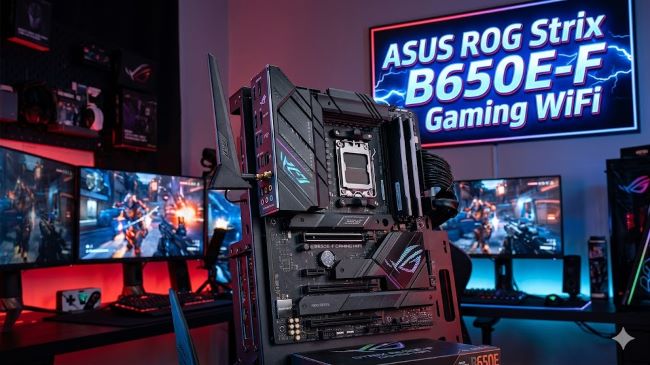
Building a high-performance gaming PC requires choosing the right foundation. The ASUS ROG Strix B650E-F Gaming WiFi represents a top-tier choice for anyone building with AMD’s latest Ryzen 7000 series processors. This B650E motherboard combines cutting-edge features with proven reliability, making it a serious contender for your next build.
Whether you’re a seasoned overclocker or someone building your first gaming PC, understanding what the ASUS ROG Strix B650E-F offers helps you make an informed decision. This guide covers everything from technical B650E-F specs to real-world performance considerations.
What Makes B650E Different
The B650E chipset sits between the budget-friendly B650 and the high-end X670E. This positioning matters because it affects what you get for your money. The E in B650E means this motherboard includes support for PCIe 5.0, a major advantage over standard B650 models.
PCIe 5.0 provides double the bandwidth of PCIe 4.0. This matters for next-generation graphics cards and ultra-fast NVMe storage. While current games don’t fully utilize this speed, PCIe 5.0 support future-proofs your build.
The ASUS ROG Strix B650E line reflects ASUS’s commitment to gaming performance without the extreme price tag of X670E models.
Power Delivery and VRM
The ASUS ROG Strix B650E-F Gaming WiFi features a 12 + 2 power stage design. This dual-phase approach handles CPU power (12 stages) and secondary components (2 stages) separately. More power stages mean better power delivery stability, especially important when running power-hungry Ryzen processors or overclocking.
This power delivery suits processors up to about 140 watts TDP. The latest Ryzen 7000 chips fit comfortably within this range at stock settings. For extreme overclocking with higher-power processors, the 12 + 2 configuration provides good but not exceptional headroom.
Users report stable temperatures under load thanks to the integrated VRM heatsinks. The cooling design prevents thermal throttling even during sustained gaming sessions.
Memory and Storage Capabilities
The B650E-F supports DDR5 memory up to 8000 MHz, with four DIMM slots accommodating up to 192 GB. This massive capacity handles gaming, content creation, and professional workloads without limitation.
DDR5 memory costs more than DDR4, but the B650E platform gives you access to faster, more power-efficient memory. Real-world gaming performance gains from DDR5 exist but remain modest compared to DDR4, though the gap narrows with demanding applications.
Storage connectivity includes three M.2 slots:
M.2 Slot 1: PCIe 5.0 x4 offers the fastest speeds. Users report sequential reads reaching 14 GB/s, though current SSDs don’t fully saturate this bandwidth.
M.2 Slot 2: PCIe 4.0 x4 remains plenty fast for gaming and productivity.
M.2 Slot 3: PCIe 4.0 x2 suits secondary storage where maximum speed isn’t critical.
Additionally, four SATA ports connect traditional hard drives or 2.5-inch SSDs for bulk storage.
Connectivity That Matters
The ASUS ROG Strix B650E-F Gaming WiFi distinguishes itself with WiFi 6E support. This newest WiFi standard operates on 2.4 GHz, 5 GHz, and 6 GHz bands, offering improved speeds and reduced congestion compared to WiFi 6.
2.5 Gbps Ethernet provides wired connectivity for those who prioritize stability over convenience. This Intel I225-V controller offers plenty of bandwidth for gaming, streaming, and content creation.
The included antenna features four-way positioning and a magnetic base for optimal signal reception regardless of case orientation.
USB connectivity includes:
1 x USB 3.2 Gen 2×2 (USB Type-C) for ultra-fast external drives
3 x USB 3.2 Gen 2 (2x Type-A, 1x Type-C) for high-speed peripherals
4 x USB 3.2 Gen 1 (Type-A) for standard high-speed devices
4 x USB 2.0 (Type-A) for keyboards, mice, and other basic devices
This comprehensive USB selection handles virtually any peripheral combination.
Audio and Aesthetics
The ROG SupremeFX audio system uses the ALC4080 codec supporting up to 32-bit/384 kHz playback. While this high-resolution audio capability exceeds typical gaming needs, it benefits audiophiles and content creators.
The Savitech amplifier reduces THD+N from 72 dB to 83 dB, delivering cleaner audio with less distortion. Premium audio capacitors and shielded audio circuits minimize electromagnetic interference.
Aesthetically, the ROG Strix B650E-F features a dark PCB with punchy brand accents. The cutout I/O shield serves dual purposes: it looks distinctive and improves VRM cooling by allowing airflow through the heatsink channels.
Aura Sync RGB allows synchronized lighting across compatible peripherals, creating a unified visual theme. The ARGB headers work with most modern RGB fans and components.
BIOS and User Experience
The ASUS BIOS earns consistent praise for intuitiveness. Users report easy navigation whether adjusting basic settings or diving into advanced overclocking options.
BIOS FlashBack simplifies firmware updates. Drop a BIOS file on a FAT32 USB stick, plug it into the dedicated port, and press the button. No CPU or RAM required.
The Q-Latch mechanism simplifies M.2 installation. Instead of traditional screws, a simple locking mechanism secures drives. This design choice makes upgrades less tedious.
Physical buttons for PCIe slot release eliminate fumbling with tiny latches when removing graphics cards. These seemingly small features accumulate into a significantly better building experience.
Real-World Performance
Users report excellent stability with Ryzen 7000 processors up to the Ryzen 9 9950X. The 12 + 2 power delivery handles both current and announced processors without thermal issues.
PCIe 5.0 M.2 performance impresses, with high-speed SSDs delivering the theoretical speeds they’re designed for. This becomes relevant as more NVMe drives supporting PCIe 5.0 hit the market.
Some users note slow BIOS boot times at default settings. Changing memory context restore settings in BIOS resolves this to normal speeds.
A few RAM compatibility issues appear in early reviews, but these largely resolved with BIOS updates. Current compatibility is excellent with modern DDR5 memory.
Who Should Consider This Motherboard
The ASUS ROG Strix B650E-F suits gamers and creators who want PCIe 5.0 support without extreme X670E pricing. It’s ideal for anyone building a high-end AMD system with a reasonable budget.
The premium price makes it overkill for casual gamers or budget-conscious builders. If you’re pairing it with a mid-range Ryzen 5 processor, you’re overspending on platform features you won’t utilize.
The WiFi 6E and 2.5 Gbps Ethernet appeal most to people who game online or stream content. Offline gamers benefit less from premium networking.
Key Takeaways
- The ASUS ROG Strix B650E-F Gaming WiFi represents an excellent mid-to-high-end B650E motherboard with PCIe 5.0 support, WiFi 6E, and strong power delivery.
- B650E specs include 12 + 2 power stages, three M.2 slots with PCIe 5.0 on the first, and support for up to 192 GB of DDR5 memory.
- WiFi 6E provides faster wireless speeds on the new 6 GHz band. 2.5 Gbps Ethernet ensures wired connectivity for gaming and streaming.
- ROG SupremeFX audio with the ALC4080 codec delivers high-fidelity sound suitable for audiophiles and content creators, though typical gamers see modest benefit.
- The ASUS BIOS proves intuitive and feature-rich. Quality-of-life improvements like Q-Latch M.2 design and physical PCIe release buttons enhance the building experience.
- Aura Sync RGB synchronizes lighting across compatible peripherals, allowing cohesive custom builds that match your aesthetic preferences.
- Real-world stability is excellent with current and announced Ryzen 7000 processors. The 12 + 2 power delivery handles demanding workloads without thermal issues.
- The premium price suits gamers and creators building high-end systems. Budget-conscious builders or those pairing with mid-range processors should consider the standard B650 models instead.