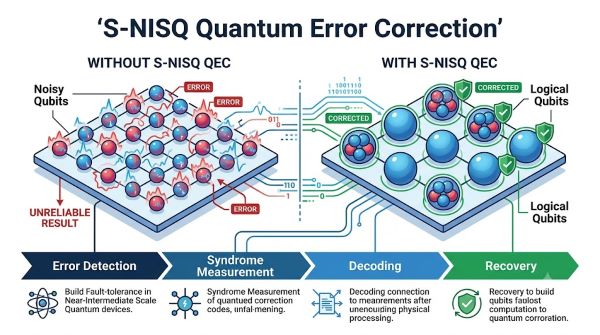
Quantum computing promises revolutionary computational power. But quantum computers face a fundamental problem. S-NISQ quantum error correction represents one approach to solving this challenge.
Most quantum computers today operate in the NISQ era (Noisy Intermediate-Scale Quantum). NISQ devices have limitations. S-NISQ is a proposed framework for improving quantum error handling. Understanding how S-NISQ quantum error correction works helps clarify the future of quantum computing.
Let’s talk about why quantum error correction matters, what NISQ and S-NISQ mean, and how we might build more reliable quantum computers.
Why Quantum Computing Is Different
Quantum computers operate on fundamentally different principles than classical computers. Classical computers use bits that are either 0 or 1. Quantum computers use qubits that exist in superposition, being both 0 and 1 simultaneously until measured.
This superposition gives quantum computers potential power. A quantum computer can explore multiple solutions at once. This parallelism could solve certain problems exponentially faster than classical computers.
But superposition comes with a cost. Qubits are fragile. Environmental interference disrupts superposition. This disruption is called decoherence. Qubits lose their quantum properties and behave like classical bits.
Additionally, quantum operations are imperfect. Quantum gates don’t execute with perfect precision. Small errors accumulate. These accumulated errors corrupt computations.
This is why quantum error correction matters. Without it, quantum computers produce unreliable results.
Understanding NISQ Era Computing
NISQ stands for Noisy Intermediate-Scale Quantum. It describes quantum computers available today and in the near term.
NISQ devices have specific characteristics. They contain 50-1000 qubits. They’re noisy, meaning errors occur frequently. They don’t have reliable error correction. They can run interesting algorithms but not perfect computations.
Current quantum computers are NISQ devices. IBM, Google, and other companies operate NISQ systems. These devices demonstrate quantum advantage on specific problems, but they’re not practical for most real-world applications.
NISQ computers serve as testbeds. Researchers use them to develop quantum algorithms and techniques. They help us understand how to build better quantum systems.
The NISQ era is temporary. As technology improves, we’ll move toward fault-tolerant quantum computers. S-NISQ is a proposed intermediate stage.
What S-NISQ Represents
S-NISQ stands for Sparse NISQ. It’s a framework proposed for quantum computing between current NISQ devices and fully fault-tolerant quantum computers.
S-NISQ systems would have characteristics midway between NISQ and fault-tolerant computers. They would have more qubits than current devices. They would have better error rates. They would implement some error correction techniques.
S-NISQ is not yet a reality. It’s a proposed architecture and framework for developing quantum computers in the next phase. Various research groups are exploring S-NISQ concepts.
The “sparse” aspect refers to using error correction selectively. Rather than implementing full error correction across all qubits, S-NISQ devices would apply error correction strategically. This approach provides error mitigation without requiring as many physical qubits as full error correction.
Understanding Quantum Error Correction Basics
Quantum error correction is a method for protecting quantum information from errors. It’s more complex than classical error correction.
Classical error correction duplicates information. If a bit is 0, store it as 000. If one bit flips, the majority vote determines the correct value.
Quantum error correction can’t use this approach. Quantum information can’t be copied due to the no-cloning theorem. You can’t duplicate a qubit’s state.
Instead, quantum error correction spreads quantum information across multiple physical qubits. The information is encoded in the relationships between qubits, not in individual qubit states.
This approach allows error detection and correction without measuring the quantum information directly. Measuring a qubit collapses its superposition, destroying quantum information.
Quantum error correction codes come in different types. Surface codes, stabilizer codes, and topological codes are examples. Each has different properties and resource requirements.
The Challenge of Implementing Quantum Error Correction
Quantum error correction requires many physical qubits to create one logical qubit. Current estimates suggest 1,000 to 10,000 physical qubits might create one reliable logical qubit.
This overhead is massive. If you want 1,000 logical qubits for a useful computation, you need 1-10 million physical qubits. Current quantum computers have 50-1,000 qubits.
This gap is why fully fault-tolerant quantum computers don’t exist yet. We need to increase qubit counts dramatically while improving error rates.
The errors themselves are varied. Decoherence causes qubits to lose their quantum state. Gate errors occur when quantum operations don’t execute perfectly. Measurement errors happen when reading qubit values.
Each error type requires different correction approaches. Some require different encoding schemes. Some require different measurement techniques.
Surface Codes and Error Correction
Surface codes are a leading approach to quantum error correction. They’re popular because they’re relatively efficient and work with nearby qubit interactions.
Surface codes arrange qubits in a 2D grid. Data qubits store information. Ancilla qubits help detect errors. The arrangement allows measuring errors without destroying information.
The basic idea involves parity checks. You measure whether two adjacent qubits have the same parity. If parity is wrong, an error occurred. You identify and correct the error.
Surface codes require relatively low overhead compared to other error correction approaches. They tolerate error rates up to about 1%. Current quantum computers have error rates of 0.1-1%, making surface codes potentially viable.
Scaling surface codes requires more qubits and better control. The architecture must support measuring many qubits simultaneously. The classical control system must process error information quickly.
S-NISQ’s Approach to Error Management
S-NISQ would use quantum error correction selectively. Rather than correcting all qubits constantly, it would apply error correction to critical qubits or stages of computation.
This selective approach reduces qubit overhead. You might use full error correction for a few qubits doing important calculations. Other qubits operate with less protection.
Another approach involves error mitigation rather than full correction. Error mitigation includes extrapolation, probabilistic error cancellation, and other techniques that don’t require extensive qubit overhead.
Error mitigation reduces the impact of errors without the massive qubit requirement of full error correction. This makes sense for S-NISQ systems with limited qubit counts.
Practical Challenges in Near Term
Implementing even limited quantum error correction faces practical challenges.
Qubit quality varies. Some qubits have better coherence than others. Some have lower error rates. Using these heterogeneous qubits complicates error correction strategies.
Control systems must measure qubits quickly and accurately. Classical computers must process measurement results and determine corrections in real time. This requires sophisticated classical computing infrastructure.
Crosstalk between qubits causes additional errors. When operating one qubit, nearby qubits sometimes get disturbed. This unintended interaction corrupts calculations.
Calibration is continuous. Qubit properties drift over time. Error correction parameters must be updated constantly. This requires frequent recalibration.
Manufacturing tolerances affect qubit behavior. Identical qubits are difficult to produce. Slight differences affect how they behave and how error correction works.
Timeline for S-NISQ Development
S-NISQ development depends on progress in qubit technology and control systems. Estimates vary, but many researchers expect S-NISQ systems within 5-10 years.
This assumes continued progress in qubit quality and control. If progress stalls, the timeline extends. If breakthroughs occur, S-NISQ could arrive sooner.
Intermediate milestones include increasing qubit counts while maintaining quality. We need to reach hundreds of high-quality qubits. We need better control systems. We need more efficient error correction codes.
Demonstrating quantum advantage on practical problems is another milestone. Current quantum advantage demonstrations use abstract problems designed to favor quantum computers. Real-world advantage requires solving problems that matter.
S-NISQ devices would bridge NISQ and fault-tolerant computing. They might demonstrate quantum advantage on more practical problems. They would serve as stepping stones toward fully fault-tolerant systems.
Current Research Directions
Many research groups work on aspects of quantum error correction and S-NISQ systems.
IBM, Google, and others develop improved qubits. They work on reducing error rates and increasing coherence times. These improvements make error correction more practical.
Researchers explore different error correction codes. Some focus on codes requiring less overhead. Others focus on codes robust to specific error types.
Control system development receives significant attention. Better measurement and control techniques reduce overhead and improve correction effectiveness.
Academic researchers and companies collaborate on S-NISQ concepts. Some propose specific S-NISQ architectures. Others develop algorithms optimized for S-NISQ resources.
Different Quantum Computing Approaches
Not all quantum computing approaches face the same error correction challenges. Different physical implementations have different error characteristics.
Superconducting qubits, the most developed technology, suffer from decoherence and gate errors. Ion traps have longer coherence times but slower gates. Photonic approaches face photon loss. Topological qubits might have inherent error protection.
Each approach drives different error correction strategies. Some technologies naturally suit certain error codes. Some have error characteristics that other codes handle better.
Hybrid approaches might combine different technologies. A quantum computer might use superconducting qubits for certain operations and trapped ions for others. This flexibility might improve overall performance.
The Path Forward
From NISQ to S-NISQ to fault-tolerant quantum computers, the path involves gradual improvements.
Qubit counts increase. Error rates decrease. Control systems improve. Error correction becomes more practical.
This progression isn’t guaranteed. Technology development faces unexpected obstacles. Breakthroughs happen. Unexpected limitations emerge.
But the direction is clear. Better quantum computers require better error handling. Quantum error correction is fundamental to future quantum computing.
S-NISQ represents a pragmatic intermediate step. Rather than waiting for fully fault-tolerant systems, S-NISQ explores what’s possible with selective, strategic error correction.
Key Takeaways
- S-NISQ quantum error correction represents a framework for quantum computers intermediate between NISQ and fully fault-tolerant systems.
- NISQ devices are current quantum computers with significant noise and limited error correction.
- S-NISQ systems would apply quantum error correction selectively rather than comprehensively across all qubits.
- Quantum error correction protects quantum information by spreading it across multiple physical qubits.
- Surface codes are a leading approach to quantum error correction with relatively low overhead requirements.
- Full error correction requires massive qubit overhead, making near-term systems impractical.
- Error mitigation techniques offer an alternative to full error correction with lower resource requirements.
- S-NISQ development depends on improved qubit quality, control systems, and error correction codes.
- Different quantum computing technologies face different error challenges and suit different correction approaches.
- Practical challenges including crosstalk, calibration, and manufacturing tolerances complicate error correction implementation.
- Current quantum computers operate in the NISQ era but work toward improved architectures.
- S-NISQ systems might demonstrate quantum advantage on more practical problems than current NISQ devices.
- Research toward S-NISQ continues across academia and industry.
- The path from NISQ to fault-tolerant quantum computing likely involves multiple intermediate steps.
- Error handling is fundamental to practical quantum computing advancement.
- S-NISQ quantum error correction represents an important step toward truly useful quantum computers.