You’re studying genetics and encounter different mutation types. The terminology is confusing. Which is a frameshift mutation substitution nonsense silent deletion is a question that appears on exams and in textbooks.
Understanding the differences between these mutation types matters for biology, genetics, and anyone interested in how DNA changes affect organisms. These mutations represent fundamentally different ways genetic material can be altered.
Let’s break down each mutation type, explain how they work, and clarify which is which.
Understanding DNA and Mutations Basics
DNA contains genetic instructions for every living organism. These instructions are written in a four-letter code: adenine (A), thymine (T), guanine (G), and cytosine (C).
The code is read in groups of three letters called codons. Each codon tells the cell to add a specific amino acid or to stop building a protein. This translation process converts DNA information into proteins.
Mutations are changes in DNA sequence. They happen when letters in the genetic code change, get added, or get deleted. Most mutations happen during DNA copying or from environmental damage.
Types of mutations fall into different categories based on how they change the DNA and what effects they have. Understanding each category helps explain genetic variation and disease.
Point Mutation Definition Biology
A point mutation definition biology refers to a change in a single nucleotide (DNA letter) in the genetic code.
Point mutations are the simplest mutations. Only one letter changes, gets added, or gets deleted. The rest of the DNA sequence remains unchanged.
Point mutations are common and usually happen during DNA replication. Most are neutral or have minor effects. Some affect protein function significantly.
Point mutation is an umbrella term that includes several subtypes: substitution, nonsense, silent, and missense mutations.
Substitution Mutation Explained
A substitution mutation occurs when one nucleotide replaces another nucleotide in the DNA sequence.
For example, if a codon reads ATG (methionine) and changes to CTG (leucine), this is a substitution mutation. One letter changed while the rest remained the same.
Substitution mutations are common and relatively simple. They change one letter to a different letter. The total number of nucleotides stays the same.
The effect depends on which letter changes and how the new codon is read. Some substitutions cause significant changes. Others have minimal effect.
Substitution mutations are not frameshift mutations. Frameshift mutations involve adding or deleting nucleotides, not substituting them. This is a key distinction.
What Is a Frameshift Mutation
A what is a frameshift mutation question gets at the heart of this concept. Frameshift mutations are fundamentally different from substitution mutations.
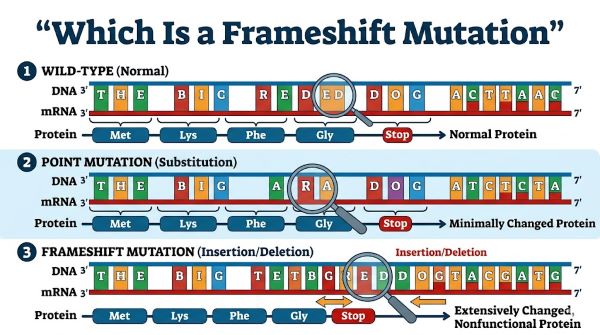
A frameshift mutation occurs when nucleotides are added to or deleted from the DNA sequence. This insertion or deletion changes how the code is read.
Imagine the genetic code as a sentence divided into words of three letters: THE CAT ATE. If you delete one letter, the sentence becomes THE CAT ATE, but it reads as THE CAT ATE with letters regrouped. The meaning changes completely because the frame shifts.
The same principle applies in genetics. If one nucleotide is deleted, all the codons after the deletion read differently. The frame shifts, changing how the code is interpreted downstream.
Frameshift mutations typically have serious consequences. The altered reading frame usually changes most amino acids in the protein. This often creates a non-functional protein.
Frameshift Mutation Example Scenario
Understanding a frameshift mutation example clarifies the concept.
Original sequence: ATG GCT AAA GTA Reading as codons: ATG (start) GCT (alanine) AAA (lysine) GTA (valine)
If we delete one nucleotide (the first T): New sequence: AGG CTA AAG TA Reading as codons: AGG (arginine) CTA (leucine) AAG (lysine) TA (incomplete)
The entire sequence reads differently. Most amino acids change. The protein would function differently or not at all.
This dramatic effect distinguishes frameshift mutations from other types. A frameshift mutation example shows why these mutations have such significant impacts.
Insertion Mutation and Deletion Mutation
Frameshift mutations include two subtypes: insertions and deletions.
An insertion mutation adds one or more nucleotides to the DNA sequence. If ATG GCT becomes ATG GCT (adding a C), the frameshift happens downstream.
A deletion mutation removes one or more nucleotides from the sequence. If ATG GCT becomes ATG CT (deleting a C), the reading frame again shifts for all downstream codons.
Both insertion mutation and deletion mutation cause frameshift effects when they add or remove nucleotides that aren’t in multiples of three.
If you add or delete exactly three nucleotides, the frame doesn’t shift. The codons after the mutation still read correctly. This is why the number of nucleotides changed matters.
Nonsense Mutation Defined
A nonsense mutation is a specific type of substitution where the codon changes to a stop codon.
Stop codons tell the cell to stop building the protein. Normal codons code for amino acids. A nonsense mutation creates a premature stop signal.
For example, if a codon changes from UAC (tyrosine) to UAA (stop), the protein stops being built too early. The resulting protein is truncated and usually non-functional.
What is a nonsense mutation is important to understand because it shows how a single change can have profound effects. One letter changes to a different letter. The reading frame doesn’t shift. But the mutation creates a stop codon prematurely.
A nonsense mutation is a point mutation but not a frameshift mutation. This distinction is crucial for answering questions about mutation types.
Silent Mutation Characteristics
A silent mutation is a substitution where the codon changes but the amino acid stays the same.
This happens because multiple codons code for the same amino acid. This redundancy in the genetic code is called degeneracy.
For example, both TTT and TTC code for phenylalanine. If TTT changes to TTC, the protein still gets phenylalanine at that position. The mutation is silent.
Silent mutation examples are common because many codon changes don’t change the resulting amino acid. The protein functions normally despite the DNA change.
Silent mutations are often neutral and don’t cause disease. They can be detected through DNA sequencing but not observed through phenotype changes.
Missense Mutation Overview
A missense mutation occurs when a substitution changes the amino acid in the protein.
If a codon changes from TTT (phenylalanine) to CTT (leucine), the amino acid changes. The protein has a different amino acid at that position.
Missense vs nonsense mutation represents two different outcomes of substitutions. Missense changes the amino acid but keeps building the protein. Nonsense stops the protein prematurely.
The severity of missense mutations depends on which amino acid changes and where in the protein the change occurs. Some changes have minimal effect. Others destroy protein function.
Missense mutation is a point mutation but not a frameshift mutation.
DNA Mutations Categories Summary
Understanding DNA mutations requires organizing them into categories.
Point mutations change a single nucleotide:
- Substitution mutations (one letter changes to another)
- Missense mutations (change the amino acid)
- Nonsense mutations (create a stop codon)
- Silent mutations (don’t change the amino acid)
Frameshift mutations add or delete nucleotides:
- Insertion mutations (add nucleotides)
- Deletion mutations (remove nucleotides)
Duplication mutations copy a DNA sequence, adding extra nucleotides.
These categories help organize the bewildering array of possible mutations.
Duplication Mutation Explanation
A duplication mutation occurs when a section of DNA is copied, resulting in extra nucleotides.
If a sequence ATG GCT is duplicated, the new sequence becomes ATG GCT ATG GCT. The section is repeated.
Duplication mutations can be frameshift mutations if they duplicate an odd number of nucleotides. They can also be neutral if the duplication includes a complete functional unit.
Duplications are interesting because they sometimes create new gene functions. The duplicated section might mutate differently than the original, creating genetic variation.
Comparing All Types of Mutations
Let’s organize the concepts:
Substitution mutations: One nucleotide changes to another. Examples: missense, nonsense, silent. Not frameshift.
Frameshift mutations: Nucleotides are added or deleted. Includes insertion and deletion mutations. Changes how all downstream codons are read.
Nonsense mutations: A specific substitution creating a stop codon. Not frameshift. Stops protein building prematurely.
Silent mutations: A substitution that doesn’t change the amino acid. Not frameshift. Usually neutral.
Missense mutations: A substitution that changes the amino acid. Not frameshift. May or may not affect protein function.
Insertion mutations: Frameshift. Adds nucleotides, shifting the reading frame.
Deletion mutations: Frameshift. Removes nucleotides, shifting the reading frame.
Duplication mutations: Copies a DNA segment. May or may not be frameshift depending on length.
Answering: Which Is a Frameshift Mutation
The original question asks: which is a frameshift mutation substitution nonsense silent deletion.
The answer is deletion (and by extension, insertion, though insertion isn’t explicitly listed).
Deletion is a frameshift mutation because it removes nucleotides, changing how all downstream DNA is read.
Substitution, nonsense, and silent are not frameshift mutations. They’re point mutations that change a single nucleotide but don’t add or delete nucleotides. The reading frame remains unchanged.
Nonsense and silent are actually types of substitution mutations with specific effects.
Real-World Examples
Understanding mutations becomes easier with real examples.
Cystic fibrosis is often caused by a deletion mutation in the CFTR gene. Three nucleotides are deleted, causing a frameshift that produces a non-functional protein. Patients cannot transport chloride ions properly, leading to thick mucus buildup.
Sickle cell disease results from a missense mutation. One nucleotide substitution changes glutamic acid to valine in the hemoglobin protein. This single amino acid change causes hemoglobin to polymerize, distorting blood cells into sickle shapes.
Duchenne muscular dystrophy often involves frameshift mutations in the dystrophin gene. Deletions or insertions cause the reading frame to shift, producing non-functional protein and causing muscle degeneration.
These examples show why understanding mutation types matters.
Effects of Different Mutation Types
Different mutations have different consequences.
Silent mutations: Usually no effect. The protein functions normally.
Missense mutations: Variable effect. Some change protein function. Others don’t.
Nonsense mutations: Severe effect. The truncated protein usually doesn’t function.
Frameshift mutations: Severe effect. The altered reading frame changes most downstream amino acids, destroying protein function.
Insertion mutations: Severe if they cause frameshift. Mild if they add three nucleotides (one complete codon).
Deletion mutations: Severe if they cause frameshift. Mild if they delete three nucleotides.
Understanding these differences explains why some mutations cause disease and others don’t.
Key Takeaways
- A frameshift mutation occurs when nucleotides are added or deleted, changing how the genetic code is read downstream.
- Which is a frameshift mutation substitution nonsense silent deletion has deletion as the frameshift mutation from the options provided.
- Substitution mutations change one nucleotide to another but don’t add or delete nucleotides.
- Nonsense mutations are substitutions that create premature stop codons.
- Silent mutations are substitutions that don’t change the amino acid.
- Deletion mutations remove nucleotides and cause frameshift if they don’t remove multiples of three.
- Insertion mutations add nucleotides and cause frameshift if they don’t add multiples of three.
- Missense mutations are substitutions that change the amino acid.
- Frameshift mutation example shows how one deleted nucleotide changes all downstream codons.
- Point mutation definition biology includes substitution, missense, nonsense, and silent mutations.
- Types of mutations range from silent with no effect to frameshift with severe consequences.
- Duplication mutations copy DNA segments and can sometimes cause frameshift effects.
- DNA mutations happen constantly but most are neutral or repaired.
- The severity of mutations depends on their type and location in the gene.
- Missense vs nonsense mutation represents two different substitution outcomes: changing amino acids versus creating stop codons.
- Understanding which is a frameshift mutation substitution nonsense silent deletion requires knowing that frameshift mutations add or delete nucleotides while the others modify single nucleotides without changing the frame.